
The Cheetah Girls (group)
Disney-born girl group that sold over 11 million records.

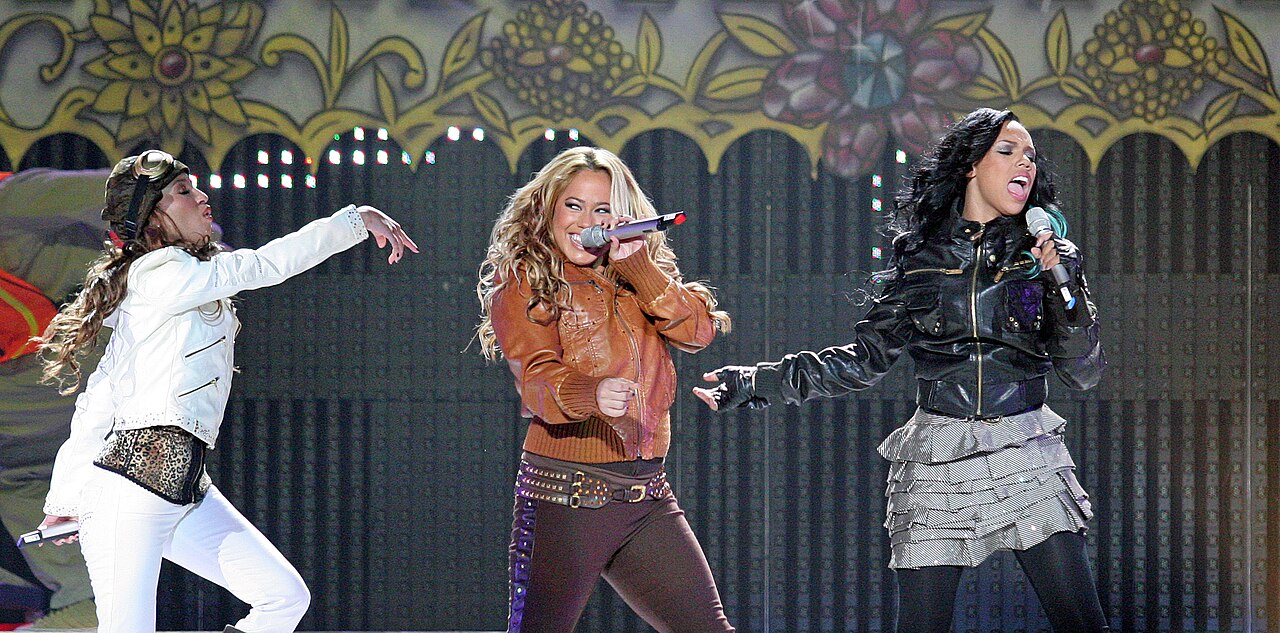
Craig ONeal · CC BY-SA 2.0
The Cheetah Girls started as a fictional group in a 2003 Disney Channel movie, based on a book series. That film set a ratings record for the network at the time, and its soundtrack went double platinum. After the movie’s success, three of the four actresses—Adrienne Bailon, Kiely Williams, and Sabrina Bryan—formed a real singing group. Raven-Symoné, who played the lead in the film, chose not to join them as a recording artist. The trio released a Christmas album in 2005, then Symoné returned for the 2006 sequel *The Cheetah Girls 2* and its double platinum soundtrack, which was her last involvement. The group put out their debut studio album of original non-Christmas material, *TCG*, in 2007 and starred in a third and final movie in 2008. They sold more than 11 million records worldwide, toured North America three times, and had merchandise including clothes, dolls, and video games.
- formed
- 2002
- disbanded
- 2008
- field
- Music, film, merchandise
- nationality
- American
- known_for
- Disney Channel musical films and soundtracks; first multi-ethnic girl music group from Disney Channel
- record_sales
- over 11 million records worldwide
Quick Facts
- Background
- group_or_band
- Genre
- R&B / pop / hip hop
- Years Active
- 2002–2008
- Label
- Walt Disney · Hollywood
- Past Members
- Adrienne Bailon / Kiely Williams / Sabrina Bryan / Raven-Symoné
Facts from the source article.
Lore & Background
The Cheetah Girls originated from the 2003 Disney Channel film The Cheetah Girls, based on the book series by Deborah Gregory. The film starred Raven-Symoné, Sabrina Bryan, Adrienne Bailon, and Kiely Williams. Its soundtrack was certified double platinum. After the film, Bailon, Williams, and Bryan formed a real trio, releasing the Christmas album Cheetah-licious Christmas in 2005. Symoné returned for the 2006 sequel The Cheetah Girls 2, which had a double platinum-certified soundtrack, and that was her final work with the group. The trio released their debut studio album of original non-Christmas material, TCG, in 2007 and starred in their final film The Cheetah Girls: One World in 2008. The group disbanded in late December 2008.
Reader's Guide
The Cheetah Girls were the first multi-ethnic girl music group to come out of the Disney Channel, featuring young performers of diverse backgrounds. Their films and soundtracks achieved significant commercial success, with the first film setting a ratings record for Disney Channel and the second film's soundtrack reaching number 5 on the Billboard 200. The group's merchandise lines included clothing, dolls, and video games. Their tours grossed over $43 million for The Party's Just Begun Tour alone. The group's legacy includes paving the way for later Disney Channel musical acts and maintaining a fan base that led to a 2026 announcement of a fourth film, The Cheetah Girls: New Gen, with Raven-Symoné returning as executive producer and lead role.
Did You Know?
- The Cheetah Girls' debut film was the highest-rated premiere for a Disney Channel Original Movie at the time, with 6.5 million viewers.
- The group's second film, The Cheetah Girls 2, had over 8.1 million viewers, again setting a record for Disney Channel.
- The group sold over 11 million records worldwide.
- Raven-Symoné did not appear in the third film because she chose not to return to focus on her solo career.
From Page to Screen: The 2003 Film That Sparked a Phenomenon
The Cheetah Girls first existed as characters in Deborah Gregory's best-selling young adult book series before Disney Channel adapted them into a musical television film. Shot across October and November 2002, the movie premiered on August 15, 2003. The casting path was unconventional: Solange Knowles was originally chosen for Aquanette but withdrew to promote her debut album Solo Star, and Kiely Williams—who had auditioned for the lead role of Galleria—stepped into the part. Adrienne Bailon and Williams both brought experience from the R&B group 3LW, while Sabrina Bryan and Raven-Symoné completed the quartet as Dorinda and Galleria. The broadcast drew 6.5 million viewers, a record for a Disney Channel Original Movie premiere and the top-rated basic cable telecast that evening. The DVD subsequently sold over 800,000 copies. The soundtrack, released August 12, 2003, had no contractual obligation to be a commercial release; producer Debra Martin Chase convinced Disney to create new contracts. It peaked at number 33 on the Billboard 200 and earned a double platinum RIAA certification, with 'Cinderella' as its sole single. The cultural wave was strong enough that ABC explored a spin-off sitcom for the 2004–2005 season, though no pilot was ever filmed.
From Fiction to the Studio: Becoming a Recording Trio
Once the 2003 film proved its commercial power, Disney moved to develop the Cheetah Girls as a genuine recording act. Raven-Symoné chose to pursue solo work, leaving Adrienne Bailon, Kiely Williams, and Sabrina Bryan as the core trio, known both by their real names and their on-screen character names. Their first group recording was a choreographed cover of 'I Won't Say (I'm in Love)' from Hercules, appearing on Disneymania 3 in February 2005. In October, the trio released Cheetah-licious Christmas under Walt Disney Records, a holiday album blending classic carols with original material, one track co-written by all three members. It reached number 74 on the Billboard 200 and sold over 375,000 copies by mid-2008. They also contributed a 'Shake a Tail Feather' cover to the Chicken Little soundtrack, released as a single in France, and launched their first headlining tour, the Cheetah-licious Christmas Tour, choreographed by Lena Giroux. By April 2006, the group had recorded 'If I Never Knew You' from Pocahontas for Disneymania 4 and were filming their sequel in Barcelona, Spain. Raven-Symoné returned for The Cheetah Girls 2, which premiered August 26, 2006, to 8.1 million viewers—a new DCOM premiere record. Its soundtrack hit number 5 on the Billboard 200 and earned platinum certification, with 'The Party's Just Begun' and 'Strut' as singles.
The Touring Machine and Commercial Empire
The Cheetah Girls built a touring and merchandise operation that rivaled major pop acts of the mid-2000s. Three North American tours anchored their live presence: the Cheetah-licious Christmas Tour in late 2005, The Party's Just Begun Tour running from September 2006 through March 2007, and the One World Tour in 2008. The Party's Just Begun Tour, choreographed and creatively directed by Lena Giroux, was the financial centerpiece, grossing over $43 million. Two of its concert dates were captured on the live album In Concert: The Party's Just Begun Tour, released July 10, 2007. Beyond the stage, the group spawned extensive merchandise lines spanning clothing, dolls, and video games, embedding the brand into the daily lives of young fans. Their commercial footprint was substantial: the group sold over 11 million records worldwide across soundtracks and studio albums. In March 2007, while still on the road, the trio recorded material for what Bailon emphasized would be a genuine studio record rather than another film soundtrack—a distinction she felt was important for audiences to recognize. That effort culminated in TCG, their second studio album, released in 2007. The group also continued their tradition of Disney soundtrack covers, contributing 'So This Is Love' from Cinderella to Disneymania 5 that same year.
The Final Chapter and Lasting Footprint
The Cheetah Girls' story concluded with the 2008 musical film The Cheetah Girls: One World, which served as both the group's final on-screen project and the centerpiece of their One World Tour. By that point, the trajectory was clear: what began as a fictional quartet in a Disney Channel movie had evolved into a real three-piece recording group with two studio albums, multiple RIAA-certified soundtracks, and a global record sales figure exceeding 11 million. Raven-Symoné's involvement had been limited to the first two films and their soundtracks, with her sole live performance alongside the trio occurring on Good Morning America in August 2006 for 'The Party's Just Begun.' After The Cheetah Girls 2, she never returned to the group's projects. The legacy of the franchise extended well beyond music: the merchandise ecosystem of clothing, dolls, and video games kept the brand visible in retail spaces, while the touring circuit demonstrated that a Disney Channel property could sustain a major concert operation. The group's brief but concentrated run—from the 2003 premiere through the 2008 finale—left a measurable mark on the landscape of teen pop, proving that a scripted musical film could launch a genuine recording career with charting singles, multi-platinum albums, and a touring infrastructure that generated tens of millions in revenue.
Gallery
Frequently Asked Questions
Who are The Cheetah Girls?
The Cheetah Girls were an American pop girl group that grew out of a 2003 Disney Channel musical film based on a book series. They became Disney Channel's first multi-ethnic girl music act, remaining active from 2002 until their 2008 breakup.
Who were the members of The Cheetah Girls?
The recording trio consisted of Adrienne Bailon, Kiely Williams, and Sabrina Bryan, while Raven-Symoné starred in the films but declined to join as a recording artist. Symoné did return for the 2006 sequel, which turned out to be her final involvement with the project.
How many records did The Cheetah Girls sell?
The group moved over 11 million records worldwide during their career. Both the 2003 and 2006 film soundtracks earned double platinum certification.
Why did The Cheetah Girls disband?
The group officially ended in 2008 after momentum faded following Raven-Symoné's departure post-2006 sequel. The trio's creative and commercial peak had largely passed by that point, leading to their dissolution.
What made The Cheetah Girls culturally significant?
Their 2003 Disney Channel debut film set a ratings record for the network at the time, and the group broke ground as Disney Channel's first multi-ethnic girl music act. They also expanded their reach into merchandise and film beyond just music.
More in American pop girl groups 1-24
Spotted an error? Know more?
This is a living reference — every entry is fact-audited, and reader corrections feed straight into our audit queue. Suggest an edit · See this site's audit record