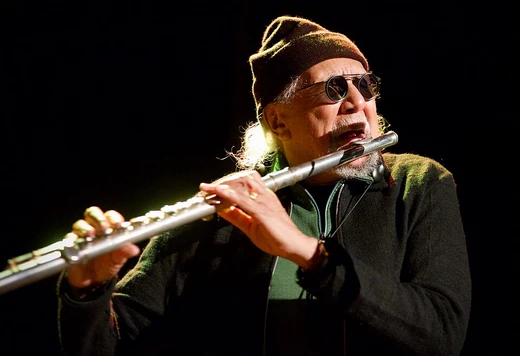
Don Alias
American jazz percussionist known for congas and drum kit.
Charles "Don" Alias (ah-LIE-ahs; December 25, 1939 – March 28, 2006) was an American jazz percussionist. He was best known for playing congas and other hand drums and also performed on drum kit. Alias played drums on the song "Miles Runs the Voodoo Down" from Miles Davis's album Bitches Brew (1969) and on the Joni Mitchell live album Shadows and Light. He performed on hundreds of recordings and was best known for his associations with Miles Davis and saxophonist David Sanborn, also working with Weather Report, Joni Mitchell, Herbie Hancock, the Brecker Brothers, Jaco Pastorius, Pat Metheny, Nina Simone, and many others.
Quick Facts
- Birth name
- Charles Alias
- Born
- 25 December 1939
- Birthplace
- New York City, New York, U.S.
- Died
- 28 March 2006
- Place of death
- New York, New York, U.S.
- Instrument
- Percussion
- Genre
- Jazz
- jazz fusion
- Latin jazz
- Occupation
- Musician
Facts from the source article.
Did You Know?
- Alias played drums on 'Miles Runs the Voodoo Down' from Bitches Brew because neither Lenny White nor Jack DeJohnette could play the marching band-inspired rhythm Davis wanted.
- Alias died at his home on March 28, 2006, at age 66, just before a planned tour with David Sanborn.
Early life
Don Alias, born in New York City on Christmas Day 1939, started on piano and guitar before switching to percussion. He learned from street rhythms and private lessons with Mongo Santamaria. At sixteen, he joined the Eartha Kitt Dance Foundation as a conga player and got his first professional gig with Dizzy Gillespie at the Newport Jazz Festival. He earned a biology degree from Gannon College and the Carnegie Institute for Biochemistry in Boston. While in Boston, he played in jazz clubs and met Berklee College of Music students, which helped him break into the music business.
Career
While at school in Boston, Alias met bassist Gene Perla, with whom he formed the jazz trio Stone Alliance in 1964. The group also included saxophonist Steve Grossman and mainly centered on jazz, Afro-Cuban, rock, and pop music. In 1976, the trio began a 15-day tour in Chile, launched through the US State Department Jazz Diplomacy program. The initial leg, with 10 locations in Chile, extended into a 6-month tour with stops in Uruguay, Brazil, Paraguay, and Argentina.
The group totaled two South American tours, four European tours, and two Canada tours. The band recorded four studio albums between 1976 and 1980, with live albums from Amsterdam, Buenos Aires, Berlin, and Bremen. After a 13-year hiatus, the group returned as a power trio with guitarist Mitch Stein playing two notable shows in New York City. His work with Nina Simone caught the eye of Miles Davis, who recruited him to play trap-set drums on Bitches Brew.
Alias played alongside Jack DeJohnette utilizing a "lean and loose" syncopation that channels inspiration from New Orleans parade tunes. Alias's most prominent work was with saxophonist David Sanborn, for whom he worked as a stage and studio player for nearly 20 years. Sanborn remarked that Alias would consistently come to sessions offering specific improvements based on the previous day's work. Sanborn said: "[Alias] immersed himself 100 percent in the music, and he gave his all to the music."
Alias was the drummer for Joni Mitchell's live album Shadows and Light, which features his drum kit on the cover. He was the studio percussionist for Mitchell's early jazz-influenced albums. On Don Juan's Reckless Daughter, he played congas, claves, snare drums, and sandpaper blocks; he also provided some background vocals. Alias played congas on the Mingus album.
Style and influence
Don Alias credited his playing style to Cuban and Puerto Rican hand drummers, whose techniques he said he picked up from the streets of New York. As such, he often played congas, bongos, and other hand drums rather than a traditional drum kit. Gene Perla was responsible for introducing Alias to singer-songwriter Nina Simone, for whom he switched gears and played a traditional full-set drum kit. This change did not present a challenge; instead, Alias thrived and eventually became her musical director. His work was important to Simone's growing interest in percussive sounds, and he's credited with a live performance on her 1970 album Black Gold.
More in American Male Jazz Musicians
Spotted an error? Know more?
Reader corrections go straight into our review queue. Suggest an edit · How this site is sourced