Fred Judd
British inventor, amateur radio operator, and early electronic music pioneer.
Last updated
Frederick Charles Judd (5 June 1914 – April 1992) worked as a radar engineer during World War II, a path similar to that of composer Tristram Cary. After the war, he joined Kelvin Hughes to research and develop marine radar, while also writing for hobbyist magazines about radio and remote-controlled models. His first book came out in 1954, and by 1959 he was technical editor for Amateur Tape Recording (ATR), covering tape, electronics, and hi-fi.
Electronic music
Alongside Daphne Oram, Judd took electronic music to the British public through lectures and demonstrations at amateur tape-recording clubs. His 1961 book Electronic Music and Musique Concrete was one of the first worldwide to offer practical guidance and circuit diagrams on the subject. Two years later, as chief editor of ATR, he began releasing 7-inch records through the magazine. He also recorded sound-effects discs for Castle and its sister label Contrast, including three of electronic music; some of these tracks later appeared on the Electronic Age album from library label Studio G.
By early 1963, Judd had built his own prototype synthesizer: a simple voltage-controlled, keyboard-operated unit for generating, shaping, and switching electronic sounds. This small but significant device predates the Synket, Moog, and Buchla instruments. That same year, the ITV sci-fi puppet show Space Patrol became the first British television series to feature a specially composed electronic music soundtrack throughout, created by Judd in his home studio using tape manipulation, loops, and tone generators.
Judd also developed Chromasonics, a system for visualising electronic sounds. He modified a black-and-white television by adding pulse-generating and amplifying circuitry, plus a high-speed colour scanning wheel in front of the screen. The result was full-colour abstract patterns that moved in sync with sound from oscillators or tape recordings. The system was well received at the 1963 London Audio Fair, but interest from electronics firm Stuzzi never led to commercial production.
Later career and legacy
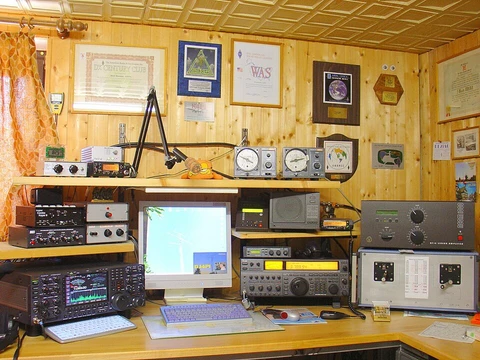
An amateur radio enthusiast with the call sign G2BCX, Judd designed the Slim Jim and ZL Special antennas, which remain in use. From the late 1970s, he operated from his home in Cantley, Norfolk. In his later years, he built detailed replicas of early electrical devices, including a Wimshurst machine and an Edison phonograph.
More in Amateur Radio People
Sources
Compiled from Wikipedia and the sources listed below. Text from Wikipedia is available under CC BY-SA 4.0; this entry is adapted from it.
- Wikipedia: Fred Judd (CC BY-SA 4.0).
Spotted an error? Know more?
Reader corrections go straight into our review queue. Suggest an edit · How this site is sourced