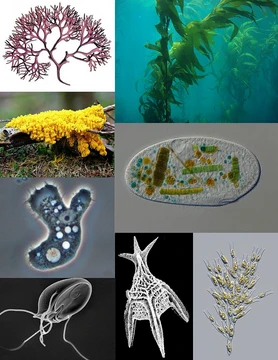
Glaucophyte
Unicellular algae with cyanelle plastids, possibly ancestral to red and green algae.

Glaucophytes are a tiny group of single-celled algae that live in freshwater and damp soil. They were far more common during the Proterozoic era than they are today. Estimates of how many species exist range from about 14 to 26. They belong to the Archaeplastida clade, alongside the much larger groups Rhodophyta (red algae) and Viridiplantae (green algae and land plants). Scientists studying how chloroplasts evolved find glaucophytes especially useful, because these algae may closely resemble the ancient ancestor that gave rise to red algae and green plants—in other words, glaucophytes could be the earliest-branching Archaeplastida.
Unlike red and green algae, glaucophytes reproduce only asexually. Their cells undergo open mitosis without centrioles, a trait shared with other early eukaryotes. They reproduce through binary fission, zoospore formation, or autosporulation. For instance, *Cyanophora paradoxa* splits lengthwise, giving each daughter cell one cyanelle. Species of *Glaucocystis* produce non-motile autospores. No evidence of sexual reproduction has ever been found in glaucophytes.
The plastids of glaucophytes are called muroplasts, cyanoplasts, or cyanelles. They are unique because they still have a peptidoglycan layer, a leftover from when a cyanobacterium was engulfed and became a plastid. This layer helps the plastid divide and is considered molecular proof of its cyanobacterial origin. Glaucophytes use chlorophyll a for photosynthesis. Like red algae and cyanobacteria, they capture light using phycobilisomes—structures packed with phycobiliproteins. (Green algae and land plants have lost this pigment system.) Also like red algae, but unlike green algae and plants, glaucophytes store fixed carbon in the cytosol rather than inside the plastid. This is thought to be an ancestral trait. Their phycobilisomes contain mainly phycocyanin and allophycocyanin, two pigments also found in cyanobacteria. These pigments absorb light at wavelengths chlorophyll cannot, which helps glaucophytes gather energy in dim aquatic environments. Studies of endosymbiotic gene transfer show that many genes originally from the cyanobacterial ancestor have moved to the glaucophyte nucleus, reflecting an early stage of plastid–host genome integration. The evolution of glycogen and starch metabolism in eukaryotes offers molecular clues about how plastid endosymbiosis became established.
The earliest-diverging genus is *Cyanophora*, which has just one or two plastids; when two are present, they remain partly connected. Glaucophyte mitochondria have flat cristae. They undergo open mitosis without centrioles. Motile species have two unequal flagella, sometimes covered in fine hairs, anchored by a multilayered system of microtubules—features also seen in some green algae.
**Phylogeny**
*External*: Glaucophytes, red algae, and Viridiplantae together make up Archaeplastida, a group of organisms that likely share a single common ancestor that took in a cyanobacterium. It remains uncertain exactly how the three groups are related, but the most probable arrangement is that glaucophytes split off first. The alternative—that glaucophytes and red algae form a separate clade—is less likely but cannot be ruled out.
*Internal*: The internal family tree of glaucophytes, and the number of genera and species, varies widely among taxonomic sources. A 2017 phylogeny divided the group into three families containing five genera. A 2019 list treated the same three subdivisions as orders and added five possible but unplaced species, for a total of 14 to 19 species.
**Taxonomy**
Order Cyanophorales: Genus *Cyanophora* – 5–6 species Order Glaucocystales: Genus *Glaucocystis* – 7–8 species Order Gloeochaetales: *Cyanoptyche* – 1 species; *Gloeochaete* – 1 species Other possible species: *Archaeopsis monococca*, *Chalarodora azurea*, *Glaucocystopsis africana*, *Peliaina cyanea*, *Strobilomonas cyaneus*
As of May 2026, AlgaeBase placed glaucophytes into only two groups, putting *Cyanophora* in Glaucocystales rather than Cyanophorales (though that entry was from 2011). AlgaeBase listed 25 species across eight genera: Glaucocystales includes *Chalarodora* (1 species), *Cyanophora* (6), *Glaucocystis* (13), *Glaucocystopsis* (1), *Peliaina* (1), and *Strobilomonas* (1); Gloeochaetales includes *Cyanoptyche* (1) and *Gloeochaete* (1). None of the glaucophyte species is particularly common in nature. Historically, glaucophytes were placed in the family Oocystaceae, order Chlorococcales.
- field
- Phycology, evolutionary biology
- known_for
- Possessing muroplasts with a peptidoglycan layer, a relic of cyanobacterial endosymbiosis; possibly basal archaeplastids
- number_of_species
- 14 to 26 (varies by source)
- habitat
- Freshwater and moist terrestrial environments
- reproduction
- Exclusively asexual (binary fission, zoospore formation, autosporulation)
Lore & Background
Glaucophytes reproduce exclusively through asexual means, unlike red and green algae. They undergo open mitosis without centrioles, a trait shared with other basal eukaryotes. Reproductive modes include binary fission, zoospore formation, and autosporulation. For example, Cyanophora paradoxa divides longitudinally, producing two daughter cells, each inheriting a single cyanelle. Species of Glaucocystis reproduce via non-motile autospores. To date, there is no evidence of sexual reproduction in glaucophytes. Their plastids, known as muroplasts, cyanoplasts, or cyanelles, have a peptidoglycan layer believed to be a relic of the endosymbiotic origin of plastids from cyanobacteria. This layer plays a functional role in plastid division and is considered molecular evidence of their cyanobacterial ancestry. Glaucophytes contain chlorophyll a and harvest light via phycobilisomes composed primarily of phycocyanin and allophycocyanin, pigments also present in cyanobacteria. Like red algae, and in contrast to green algae and plants, glaucophytes store fixed carbon in the cytosol, a retained ancestral trait.
Reader's Guide
Glaucophytes hold a key position in understanding the evolution of photosynthetic eukaryotes. As members of Archaeplastida, they share a common ancestor with red algae and green plants that established an endosymbiotic association with a cyanobacterium. The relationship among the three groups remains uncertain, although it is most likely that glaucophytes diverged first. Their plastids retain a peptidoglycan layer, a primitive feature lost in other archaeplastids, providing direct evidence of cyanobacterial ancestry. Studies of endosymbiotic gene transfer suggest that several genes originally encoded in cyanobacterial ancestors have been relocated to the nuclear genome in glaucophytes, reflecting early stages of plastid-host genomic integration. The evolution of glycogen and starch metabolism in eukaryotes gives molecular clues to understand the establishment of plastid endosymbiosis. None of the species of Glaucophyta is particularly common in nature.
Did You Know?
- Glaucophytes reproduce exclusively through asexual means; there is no evidence of sexual reproduction.
- Their plastids, called muroplasts or cyanelles, have a peptidoglycan layer that is a relic of their cyanobacterial origin.
- Glaucophytes store fixed carbon in the cytosol, unlike green algae and plants which store it in plastids.
- The most early-diverging genus is Cyanophora, which has one or two plastids that are semi-connected when two are present.
More in Algae & Protists 1-19
Spotted an error? Know more?
This is a living reference — every entry is fact-audited, and reader corrections feed straight into our audit queue. Suggest an edit · See this site's audit record