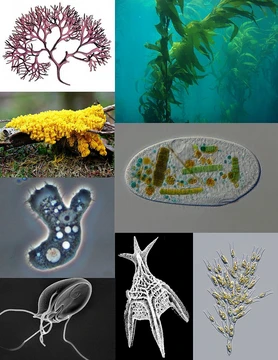
Euglenid
Single-celled flagellates with diverse nutrition and flexible pellicles.
Last updated
Euglenids, also known as euglenoids, are a diverse group of single-celled eukaryotic flagellates classified in the phylum Euglenozoa, class Euglenida or Euglenoidea. They are best known for their flagella, or whip-like tails, and are commonly found in fresh water rich in organic materials, with a few marine and endosymbiotic members. Their significance lies in their varied modes of nutrition—phagocytosis, osmotrophy, and photosynthesis—and their distinctive cell covering called a pellicle, which can be rigid or flexible, enabling a unique inching motion known as metaboly.
Scientific classification
- CladeEukaryota
- PhylumEuglenozoa
- ClassEuglenida
Named by Butschli 1884, emend. Simpson 1997
Sources: Wikipedia taxobox: Euglenid (CC BY-SA 4.0)
Quick Facts
- Field
- Protistology
- Classification
- Phylum Euglenozoa
- class Euglenida/Euglenoidea
- supergroup Discoba
- Earliest fossil
- Moyeria, from Middle Ordovician and Silurian rocks
Facts from the source article.
Background
Euglenids split from other Euglenozoa more than a billion years ago. Their plastids in all extant photosynthetic species result from secondary endosymbiosis between a euglenid and a green alga. Later, A.
More in Algae And Protists
Sources
Compiled from Wikipedia and the sources listed below. Text from Wikipedia is available under CC BY-SA 4.0; this entry is adapted from it.
- Wikipedia: Euglenid (CC BY-SA 4.0).
- Word definitions: the Codexery glossary, each quoted from its Wikipedia article.
Spotted an error? Know more?
Reader corrections go straight into our review queue. Suggest an edit · How this site is sourced