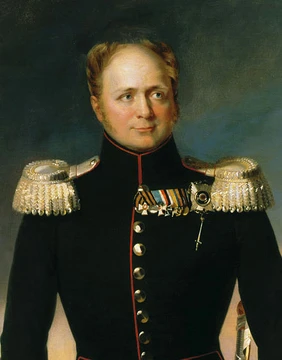
Holy Alliance
Coalition of Austria, Prussia, and Russia against secular liberalism.
Last updated

via Wikipedia: Holy Alliance · see source
The Holy Alliance, also called the Grand Alliance, was a coalition linking the absolute monarchist great powers of Austria, Prussia, and Russia. It was created after the final defeat of Napoleon at the behest of Emperor Alexander I of Russia and signed in Paris on 26 September 1815. The conservative alliance aimed to restrain secular liberalism in Europe in the wake of the devastating French Revolutionary Wars and the Napoleonic Wars; it nominally succeeded in this until the Crimean War.
Quick Facts
- Also known as
- Grand Alliance
- Signed
- 26 September 1815
- Location
- Paris
- Founder
- Emperor Alexander I of Russia
- Member states
- Austria
- Prussia
- Russia
- Primary aim
- Restrain secular liberalism in Europe
Facts from the source article.
Establishment
The Holy Alliance, also known as the Grand Alliance, was a pact among the absolute monarchies of Austria, Prussia, and Russia, created after Napoleon’s final defeat at the urging of Tsar Alexander I and signed in Paris on 26 September 1815. Its purpose was to curb secular liberalism across Europe following the French Revolutionary and Napoleonic Wars, a goal it largely achieved until the Crimean War. Otto von Bismarck later revived it as the League of the Three Emperors after German unification in 1871, but it weakened by the 1880s due to Austrian and Russian disputes over the declining Ottoman Empire.
Alexander I, guided by his spiritual advisor Baroness Barbara von Krüdener, designed the alliance to enforce the divine right of kings and Christian values in politics. He wrote the treaty, with edits from Ioannis Kapodistrias and Alexandru Sturdza, requiring rulers to govern as “branches” of the Christian community and serve each other. His initial draft, proposing a mystical unified Christian empire, unsettled other monarchs, so a more practical version was adopted by Russia, Prussia, and Austria.
French diplomat Dominique-Georges-Frédéric Dufour de Pradt called it “an apocalypse of diplomacy.” The agreement was initially secret and distrusted by liberals, yet it effectively restrained liberalism until the Revolutions of 1848. About three months after the Congress of Vienna’s Final Act, the Catholic, Protestant, and Orthodox monarchs pledged to act with “justice, love, and peace” in domestic and foreign affairs to “consolidate human institutions and remedy their imperfections.”
Britain, the Papal States, and the Ottoman Empire rejected it, though George IV consented as King of Hanover. British Foreign Secretary Lord Castlereagh dismissed it as “a piece of sublime mysticism and nonsense,” but Britain still joined the Concert of Europe. In the late 1820s, Charles X of France sought an alliance with Russia to bolster his conservative monarchy through shared anti-revolutionary interests.
Organisation
Prince Klemens von Metternich, Austria's state chancellor and foreign minister, turned the Holy Alliance into a tool for crushing democracy and citizen-led nationalism. It also enabled the three eastern powers to coordinate the suppression of Polish independence efforts: Austria in the Kingdom of Galicia and Lodomeria, Russia in its Congress Poland, and Prussia in the Grand Duchy of Posen and West Prussia. The Holy Alliance is typically linked to the later Quadruple and Quintuple Alliances, which brought in the United Kingdom and, from 1818, France to preserve the European peace settlement and balance of power established at the Congress of Vienna.
At the Congress of Aix-la-Chapelle on September 29, 1818, Tsar Alexander, Emperor Francis I of Austria, and King Frederick William III of Prussia met with the Duke of Wellington, Viscount Castlereagh, and the Duc de Richelieu to call for harsh action against university "demagogues," a demand that became the Carlsbad Decrees the following year. During the Congress of Troppau in 1820 and the subsequent Congress of Laibach in 1821, Metternich sought to unite his allies in putting down the Carbonari revolt against King Ferdinand I of the Two Sicilies.
The Quintuple Alliance held its final meeting at the Congress of Verona in 1822, where it advised against supporting the Greek Revolution and decided on a French invasion of Spain. The Münchengrätz Convention, signed on September 19, 1833, came out of talks held from September 10 to 20 of that year. It involved the Russian Empire, represented by Tsar Nicholas I and Count Nesselrode; the Austrian Empire, represented by Emperor Francis II and Clement Metternich; and the Kingdom of Prussia, represented by King Frederick William III and Friedrich Ancillon.
The agreement aimed to maintain political stability and suppress revolutionary threats during a period of ideological tension in Europe, reinforcing the conservative alliance strategies that were central to Metternich's foreign policy.
More in Alexander I of Russia
Sources
Compiled from Wikipedia and the sources listed below. Text from Wikipedia is available under CC BY-SA 4.0; this entry is adapted from it.
- Wikipedia: Holy Alliance (CC BY-SA 4.0).
Spotted an error? Know more?
Reader corrections go straight into our review queue. Suggest an edit · How this site is sourced