Glioblastoma

Jensflorian · CC BY-SA 3.0
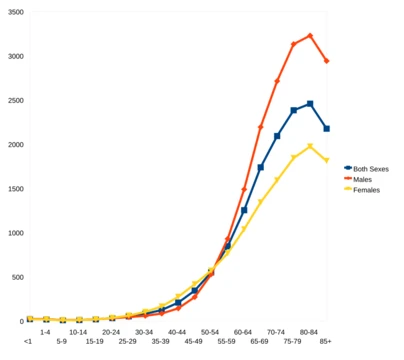
Among cancers originating in the brain, glioblastoma is both the most common and the most aggressive, and it carries a very poor prognosis.[1] After diagnosis, survival typically ranges from 10 to 13 months, and less than 5–10% of patients live beyond five years.[2] The disease develops in about 3 per 100,000 people annually, and the average age when it is found is 64.[2]
Quick Facts
- Field
- Neuro-oncology, neurosurgery
- Symptoms
- Initially nonspecific
- headaches
- personality changes
- nausea
- symptoms similar to a stroke
- Onset
- ~64 years old
- Causes
- Usually unclear
- Diagnosis
- CT scan
- MRI scan
- tissue biopsy
- Treatment
- Surgery
- chemotherapy
- radiation
- Medication
- Temozolomide, corticosteroids
Facts from the source article.
Key facts and history
The rate of new cases of brain and other nervous system cancer was 6.1 per 100,000 men and women per year based on 2019–2023 cases, age-adjusted.[3] Percival Bailey and Harvey Cushing first used the name glioblastoma multiforme in 1926, believing the tumor arises from primitive glial cell precursors.[4] For the majority of glioblastoma cases, the cause remains unknown.[5] Ionizing radiation exposure is the most established risk factor, and radiation from CT scans is a significant contributor.[6]
An oncogenic CMV infection might even be required for glioblastoma to develop.[7] It is not known from which cell type glioblastoma originates.[8] Currently, only IDH wild-type tumors receive the diagnosis of glioblastoma.[9]
What the research sources say
The SEER database reports that the death rate for brain and other nervous system cancer was 4.4 per 100,000 men and women per year based on 2020–2024 deaths, age-adjusted.[3] Brain and other nervous system cancer is most frequently diagnosed among people aged 65–74.[3] A 2025 article from Curetoday states that NEO100-01, an intranasal perillyl alcohol therapy, targets IDH1-mutant astrocytomas, aiming to bypass the blood-brain barrier.[10] The same source notes that FDA designations for NEO100-01 include Orphan Drug, Fast Track, and Rare Pediatric Disease, offering incentives and expedited review.[10]
A phase 2a clinical trial of NEO100-01 is continuing to recruit patients with malignant gliomas, with full enrollment expected in September.[10] Six patients are left to complete the 25-patient enrollment target of the trial, according to a news release from clinical-stage biopharmaceutical company NeOnc Technologies Holdings, Inc.[10]
Gallery
References
- Wikipedia, "Glioblastoma" (CC BY-SA 4.0), which cites: "Recent advances in the molecular understanding of glioblastoma", Journal of Neuro-Oncology, May 2012, p. 11–27; "Management of glioblastoma: State of the art and future directions", CA, July 2020, p. 299–312; "Survival comparison between glioblastoma multiforme and other incurable cancers", Journal of Clinical Neuroscience, April 2010, p. 417–421; "Current trends in the surgical management and treatment of adult glioblastoma", Annals of Translational Medicine, June 2015, p. 121; "Current trends in the surgical management and treatment of en.wikipedia.org
- Wikipedia, "Glioblastoma" (CC BY-SA 4.0), which cites: "Nonsurgical treatment of recurrent glioblastoma", Current Oncology, August 2015, p. e273–e281; "Radiomic Analysis to Predict Histopathologically Confirmed Pseudoprogression in Glioblastoma Patients", Advances in Radiation Oncology, 6 February 2022; "Effects of radiotherapy with concomitant and adjuvant temozolomide versus radiotherapy alone on survival in glioblastoma in a randomised phase III study: 5-year analysis of the EORTC-NCIC trial", The Lancet. Oncology, M; "CBTRUS Statistical Report: Primary Brain and Other Central Nervous Syste en.wikipedia.org
- "Cancer of the Brain and Other Nervous System - Cancer Stat Facts", SEER. facts only, no text reused. seer.cancer.gov
- Wikipedia, "Glioblastoma" (CC BY-SA 4.0), which cites: Bailey & Cushing: Tumors of the Glioma Group. JB Lippincott, Philadelphia, 1926. (original not read by us) en.wikipedia.org
- Wikipedia, "Glioblastoma" (CC BY-SA 4.0), which cites: "World Cancer Report 2014", World Health Organization, 2014; "World Cancer Report 2014", World Health Organization, 2014; "Nonsurgical treatment of recurrent glioblastoma", Current Oncology, August 2015, p. e273–e281; "Current trends in the surgical management and treatment of adult glioblastoma", Annals of Translational Medicine, June 2015, p. 121; "World Cancer Report 2014", World Health Organization, 2014; "Current trends in the surgical management and treatment of adult glioblastoma", Annals of Translational Medicine, June 2015, p. 121 en.wikipedia.org
- Wikipedia, "Glioblastoma" (CC BY-SA 4.0), which cites: "World Cancer Report 2014", World Health Organization, 2014; Smoll, "Computed tomography scan radiation and brain cancer incidence", Neuro-Oncology, 6 July 2023, p. 1368–1376; Smoll, "Exposure to ionizing radiation and brain cancer incidence: The Life Span Study cohort", Cancer Epidemiology, June 2016, p. 60–65; "Glioblastoma multiforme: Pathogenesis and treatment", Pharmacology & Therapeutics, August 2015, p. 63–82 (original not read by us) en.wikipedia.org
- Wikipedia, "Glioblastoma" (CC BY-SA 4.0), which cites: "Simian virus 40 in human cancers", The American Journal of Medicine, June 2003, p. 675–684; "Detection of human herpesvirus-6 variants in pediatric brain tumors: association of viral antigen in low grade gliomas", Journal of Clinical Virology, September 2009, p. 37–42; "Human herpesvirus 6 latent infection in patients with glioma", The Journal of Infectious Diseases, November 2012, p. 1394–1398; "The Viral Connection to Glioblastoma", Current Infectious Disease Reports, February 2017; El Baba, "EZH2-Myc driven glioblastoma elicited by cyt en.wikipedia.org
- Wikipedia, "Glioblastoma" (CC BY-SA 4.0), which cites: "The cellular origin for malignant glioma and prospects for clinical advancements", Expert Review of Molecular Diagnostics, May 2012, p. 383–394; "Cell of origin for malignant gliomas and its implication in therapeutic development", Cold Spring Harbor Perspectives in Biology, January 2015 (original not read by us) en.wikipedia.org
- Wikipedia, "Glioblastoma" (CC BY-SA 4.0), which cites: "The 2021 WHO Classification of Tumors of the Central Nervous System: a summary", Neuro-Oncology, August 2021, p. 1231–1251 (original not read by us) en.wikipedia.org
- "Clinical Trial of NEO100 Recruiting Patients With Malignant Gliomas", Curetoday, 2025-04-15. facts only, no text reused. curetoday.com
Each numbered sentence above was checked against the source it cites before publication. Sentences citing Wikipedia adapt text from the English Wikipedia article Glioblastoma (contributors), used under CC BY-SA 4.0; this entry is available under the same licence. Other sources were used for facts only; no text or images are copied from them.
More in Aging-associated diseases
Spotted an error? Know more?
Reader corrections go straight into our review queue. Suggest an edit · How this site is sourced