Frequently Asked Questions
The most-asked questions about agamemnon.
Who is Agamemnon?
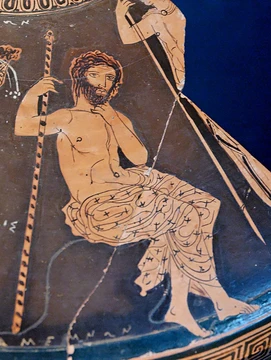
Agamemnon is the king of Mycenae and the supreme commander of the Greek coalition during the Trojan War. He is the eldest son of Atreus and the brother of Menelaus, placing him at the center of both Homer's Iliad and the later tragic cycle.
What is Agamemnon's role in the Trojan War?
He leads the assembled Greek forces against Troy, serving as the political and military authority over all the allied kings. His decisions—most notably the quarrel with Achilles over Briseis—drive much of the Iliad's central plot.
What is the Oresteia and how does Agamemnon feature in it?
The Oresteia is Aeschylus's three-part tragedy (Agamemnon, The Libation Bearers, The Eumenides) that dramatizes the cycle of vengeance in the House of Atreus. Agamemnon is the protagonist of the first play, in which he is murdered by his wife Clytemnestra upon returning from Troy.
Who are the key figures connected to Agamemnon?
His closest relationships are with his wife Clytemnestra, his brother Menelaus, his daughter Iphigenia, and his son Orestes. On the Greek side, his rivalry with the warrior Achilles forms the Iliad's central tension.
Where should a newcomer start to learn about Agamemnon?
Homer's Iliad offers the broadest picture of his role as war-leader, while Aeschylus's play Agamemnon gives the most focused dramatic treatment of his character and death. Reading or watching the Iliad first, then the Oresteia, is a natural progression.
What is the Iphigenia sacrifice and why is it significant?
Agamemnon is compelled to sacrifice his daughter Iphigenia to appease Artemis and secure favorable winds for the Greek fleet's departure to Troy. This act creates the deep resentment in Clytemnestra that ultimately motivates her revenge.
How does Agamemnon die?
He is ambushed by Clytemnestra (and in most versions, her lover Aegisthus) as he enters his own palace after the war. In Aeschylus's version, she kills him as he steps into a bath, framing the act as retribution for the Iphigenia sacrifice.
What major themes does Agamemnon embody in Greek literature?
He represents the tensions between royal authority and personal honor, the cost of political power, and the inescapable cycle of blood vengeance within a family. His story also explores the conflict between public duty and private loyalty.
What are the primary ancient sources for Agamemnon's story?
The main texts are Homer's Iliad, Aeschylus's Oresteia (458 BCE), and Euripides's Iphigenia at Aulis and Iphigenia in Tauris. Later sources include Apollodorus's Bibliotheca and various scholia on Homer.
What makes Agamemnon a compelling character for fans and scholars?
He is neither a pure hero nor a simple villain; his nobility is constantly tested by pride, political calculation, and the weight of inherited sin. This moral complexity is why he remains a rich subject for retellings, adaptations, and scholarly debate.