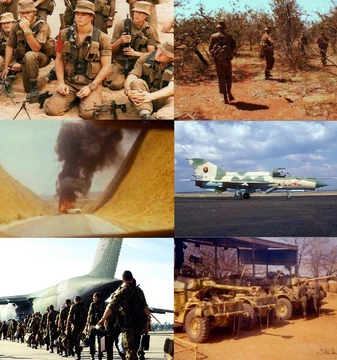
Ifni War
Armed conflict over Spanish colonial holdings in West Africa.

Hostilities ceased in April 1958 with the Treaty of Angra de Cintra, transferring Cape Juby and most of the Ifni territory to Morocco, though Sidi Ifni remained under Spanish control until 1969.
- End
- April 1958 (Treaty of Angra de Cintra)
- Location
- Spanish West Africa (Ifni and Spanish Sahara)
- Belligerents
- Spain (with French support) vs. Moroccan insurgents (later Moroccan Army of Liberation)
- Outcome
- Morocco gained Cape Juby and most of Ifni; Spain retained Sidi Ifni until 1969
Quick Facts
- Conflict
- Ifni War
- Part Of
- the decolonisation of Africa
- Date
- 23 November 1957 – 30 June 1958 / (month1=10 · day1=23 · year1=1957 · month2=06 · day2=30 · year2=1958)
- Location
- Ifni, Spanish Sahara, Morocco
- Result
- Franco−Spanish military victory / Moroccan political victory / Treaty of Angra de Cintra
- Territory
- Areas of Ifni annexed by Morocco / Cape Juby ceded to Morocco by Spain / Sidi Ifni retained by Spain until 1969
- Combatant1
- Francoist Spain · 1957 Spain / Francoist Spain · 1957 West Africa · French Fourth Republic · 1957 French Union (1958) / French Fourth Republic · 1957 Mauritania
- Combatant2
- Morocco Morocco / Army of Liberation / Allied Sahrawi tribes
- Commander1
- Francoist Spain Francisco Franco / French Fourth Republic Charles De Gaulle
- Commander2
- Morocco Ben Hammu
- Strength1
- 15,300 men / 10,300 Spanish troops / 5,000 French troops / 150 aircraft
- Strength2
- 30,000 men
Facts from the source article.
Lore & Background
At Tiliuín, 60 Tiradores de Ifni held off several hundred Moroccans until a relief force of paratroopers and Legion battalions broke the siege on 3 December. The relief of Telata was less successful: a platoon of paratroopers under Captain Ortiz de Zárate suffered heavy casualties and only reached Sidi Ifni on 5 December. In January 1958, Morocco reorganized its units as the Saharan Liberation Army, which attacked El Aaiún and ambushed Spanish forces at Edchera, but was beaten back.
Reader's Guide
The Ifni War, though often overshadowed by larger decolonization conflicts, marked a significant chapter in Spain's colonial retreat from Africa. It demonstrated the limits of Spanish military power in the face of organized nationalist movements, even as Franco's forces managed to hold key positions. The war's outcome—the transfer of Cape Juby and most of Ifni to Morocco in 1958, and the eventual return of Sidi Ifni in 1969 under UN pressure—reflected broader international trends toward decolonization. The conflict also highlighted the role of local tribal allies and the use of elite Spanish Legion units. The Treaty of Angra de Cintra, signed in April 1958, formalized the territorial changes, though small skirmishes continued. The Ifni War remains a relatively obscure episode, but it shaped the modern borders of Morocco and Western Sahara.
Did You Know?
- The Ifni War is sometimes called the Forgotten War (la Guerra Olvidada) in Spain.
- The Treaty of Angra de Cintra, signed in April 1958, transferred Cape Juby and most of Ifni to Morocco, but Sidi Ifni remained Spanish until 1969.
Frequently Asked Questions
What is the Ifni War?
The Ifni War was an armed conflict fought over Spain's remaining colonial territories in West Africa, specifically the Ifni region and the Spanish Sahara. It is catalogued as entry 1-19 in the broader series of African wars of independence.
Who were the belligerents in the Ifni War?
Spain, backed by French support, faced off against Moroccan insurgents who later organized into the Moroccan Army of Liberation. The conflict was essentially a colonial power holding its West African territories against a neighboring nation seeking to reclaim them.
When and how did the Ifni War end?
Hostilities came to a close in April 1958 through the Treaty of Angra de Cintra. This agreement transferred Cape Juby and the majority of the Ifni territory to Moroccan sovereignty.
What was the final territorial outcome of the Ifni War?
Morocco secured Cape Juby and most of the Ifni region, while Spain kept hold of the Sidi Ifni enclave until 1969. So the conflict produced a partial rather than complete transfer of Spanish colonial land.
Why is the Ifni War significant in the broader decolonization context?
It marked another step in the dismantling of European colonial empires in Africa, as a neighboring independent state successfully pressured a European power to cede territory. Its resolution in 1958 fits squarely within the wave of African independence movements of the late 1950s.
More in African Wars Of Independence 1-19
Spotted an error? Know more?
This is a living reference — every entry is fact-audited, and reader corrections feed straight into our audit queue. Suggest an edit · See this site's audit record