Marlon James (novelist)
Jamaican novelist and Man Booker Prize winner.

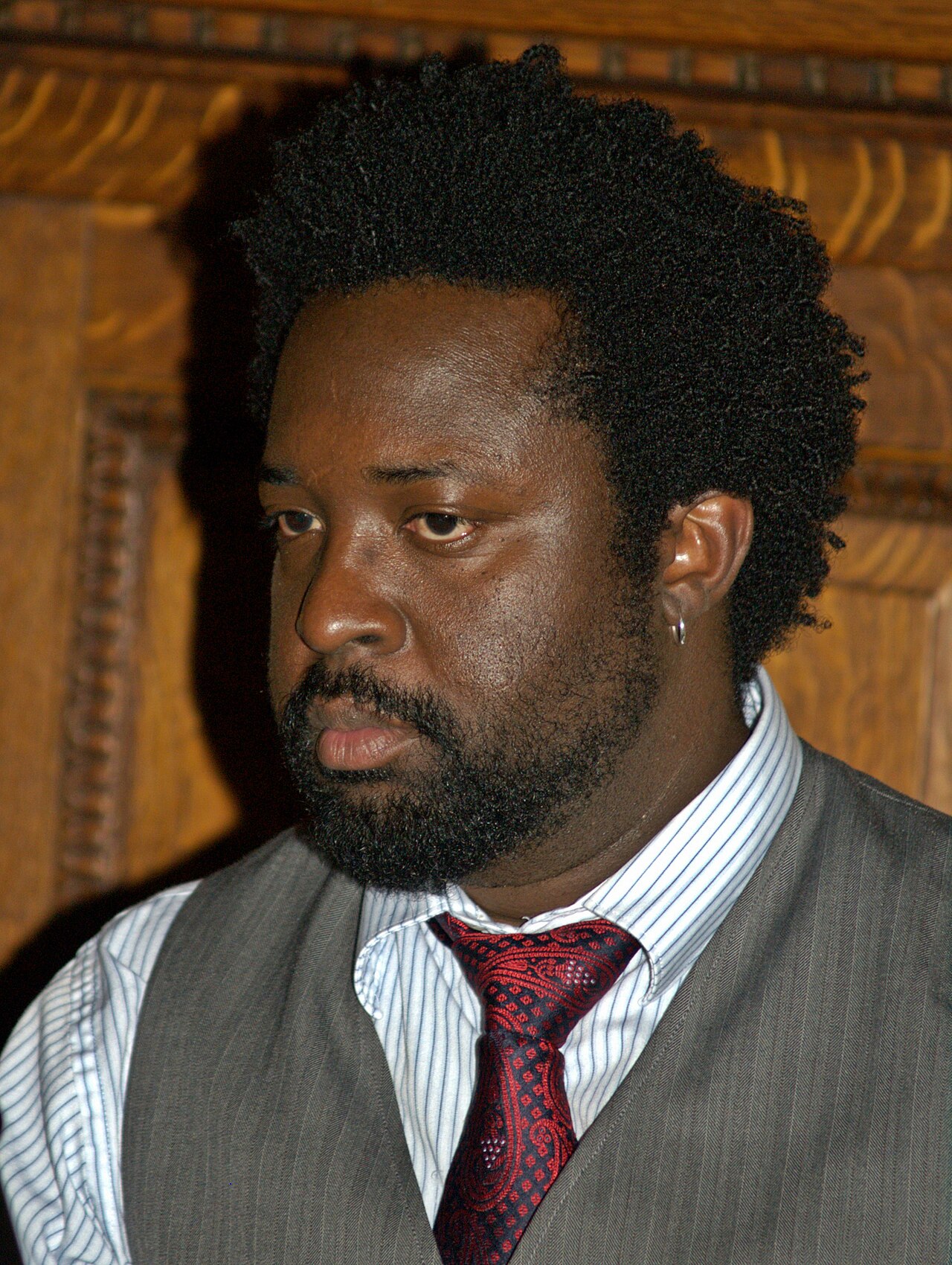
David Shankbone · CC BY 3.0
Marlon James, a Jamaican novelist, was born on 24 November 1970. He has published six novels: *John Crow's Devil* (2005), *The Book of Night Women* (2009), *A Brief History of Seven Killings* (2014), *Black Leopard, Red Wolf* (2019), *Moon Witch, Spider King* (2022), and *The Disappearers* (2026). He also created the limited television series *Get Millie Black*. James now lives in Minneapolis, Minnesota, and teaches literature at Macalester College in Saint Paul, Minnesota. He also serves as a faculty lecturer in the Low Residency MFA in Creative Writing at St. Francis College.
James grew up in Kingston, Jamaica. Both his parents worked in the Jamaican police force: his mother, who gave him his first prose book (a collection of O. Henry stories), became a detective; his father, from whom James inherited a love of Shakespeare and Coleridge, was a lawyer. He attended Wolmer's Trust High School for Boys in Kingston. In 1991, he graduated from the University of the West Indies, where he studied language and literature. He left Jamaica to escape anti-gay violence and economic conditions he believed would stall his career, later stating, "Whether it was in a plane or a coffin, I knew I had to get out of Jamaica." He earned an MFA in creative writing from Wilkes University in Pennsylvania in 2006.
His debut novel, *John Crow's Devil* (2005), was rejected seventy times before publication. It depicts a biblical struggle between good and evil in a remote Jamaican village in 1957. His second novel, *The Book of Night Women* (2009), centers on a slave woman's revolt on an early-19th-century Jamaican plantation. *A Brief History of Seven Killings* (2014) uses multiple narrators to examine decades of Jamaican political turmoil. It won the 2015 OCM Bocas Prize for Caribbean Literature in fiction and the 2015 Man Booker Prize for Fiction, making James the first Jamaican author ever shortlisted for that award. He is the second Caribbean winner of the Booker, after Trinidad-born V. S. Naipaul (1971). *Moon Witch, Spider King* (2022) is the second installment in a planned fantasy series that began with *Black Leopard, Red Wolf* (2019).
Since 2007, James has taught English and creative writing at Macalester College. In 2016, he was the subject of the BBC arts documentary *The Seven Killings of Marlon James*, part of the *Imagine* series, presented by Alan Yentob. He delivered the seventh annual Tolkien Lecture at Pembroke College, Oxford, in February 2019. In 2020, he co-launched the literary podcast "Marlon and Jake Read Dead People" with his editor Jake Morrissey, exploring deceased authors' work in a casual format. He was a James Merrill House Fellow in Stonington, Connecticut, in 2021, and that year began writing his first television series, *Get Millie Black*, for HBO and Channel 4. The series aired on HBO in 2024 and on Channel 4 in 2025, earning critical acclaim. James received a 2026 Guggenheim Fellowship in Fiction. In July 2026, his novel *The Disappearers* was longlisted for the Booker Prize.
Recurring themes in James's work include religion, the supernatural, sexuality, violence, and colonialism. His novels frequently explore the search for identity, whether as a slave or a postcolonial Jamaican.
In *John Crow's Devil*, James uses a religiously charged battle between good and evil to examine postcolonial Jamaica. His archetypal characters represent aspects of humanity, including hope, and the novel functions as Caribbean gothic, revealing guilt, hypocrisy, and truths about human nature. Colonialism's ghosts are subtle, but the instability and identity struggles are clear.
*The Book of Night Women* challenges traditional slave narratives through its protagonist, Lilith, who approaches enslavement with complex duality. She hates the masters but seeks privileged status by submitting sexually to the white overseer Robert Quinn, complicating the reader's sympathies. James intends readers to root for the pair, then catch themselves, given Quinn's brutality—he even orders Lilith whipped. Quinn's Irishness sometimes earns him sympathy, but his whiteness ultimately dominates. The novel also explores womanhood, with female slaves connected to Obeah and Myal spiritualism, portrayed as strong and intelligent, while male slaves are often weak or traitorous. Rape, torture, murder, and other dehumanizing acts drive the narrative, shocking in their depravity and humanness. The book defies hegemonic empire by highlighting explosive antagonisms.
- born
- 24 November 1970
- field
- Novelist, television writer, academic
- nationality
- Jamaican
Lore & Background
Marlon James was born in Kingston, Jamaica, to parents who both served in the Jamaican police: his mother became a detective and his father was a lawyer. He attended Wolmer's Trust High School for Boys and graduated from the University of the West Indies in 1991, where he studied language and literature. He left Jamaica to escape anti-gay violence and economic stagnation, later stating, 'Whether it was in a plane or a coffin, I knew I had to get out of Jamaica.' He earned an MFA in creative writing from Wilkes University in 2006. James's first novel, John Crow's Devil (2005), was rejected 70 times before publication. A Brief History of Seven Killings (2014) uses multiple narrators to explore Jamaican history and political instability. James is the second Caribbean winner of the Booker, after V. S. Naipaul (1971). He has since written Black Leopard, Red Wolf (2019) and its sequel Moon Witch, Spider King (2022), part of a planned fantasy trilogy. James has taught English and creative writing at Macalester College in Saint Paul, Minnesota, since 2007, and is a faculty lecturer at St. Francis College's Low Residency MFA in Creative Writing. He lives in Minneapolis, Minnesota. In 2021, he was a James Merrill House Fellow, and in 2026 he received a Guggenheim Fellowship in Fiction. His novel The Disappearers was longlisted for the Booker Prize in July 2026.
Reader's Guide
Marlon James's significance lies in his reimagining of Caribbean literature through genre-bending narratives that confront colonialism, violence, and identity. A Brief History of Seven Killings expanded the scope of postcolonial fiction by employing a polyphonic structure and a 'poetics of excess' to critique nationalism and global inequality. His fantasy series, beginning with Black Leopard, Red Wolf, challenges Eurocentric fantasy conventions by setting an epic quest in a mythic ancient Africa, drawing comparisons to works by Tomi Adeyemi and N. K. Jemisin. James's work consistently defies easy categorization, blending historical realism with supernatural elements, and his novels often force readers to confront uncomfortable moral complexities, such as the ambiguous relationship between a slave and her overseer in The Book of Night Women. His influence extends beyond literature into television and podcasting, and his teaching at Macalester College has shaped a new generation of writers. As a Jamaican expatriate, his personal narrative of leaving Jamaica due to anti-gay violence and economic constraints underscores the broader themes of exile and identity in his fiction.
Did You Know?
- James's first novel, John Crow's Devil, was rejected 70 times before being accepted for publication.
- He is the first Jamaican author to be shortlisted for and win the Man Booker Prize.
- James co-hosts a literary podcast called 'Marlon and Jake Read Dead People' with his editor Jake Morrissey.
- In February 2019, he gave the seventh annual Tolkien Lecture at Pembroke College, Oxford.
Gallery


Frequently Asked Questions
Who is Marlon James (novelist)?
Marlon James is a Jamaican-born author, born on 24 November 1970, who works across fiction, television writing, and academia. He is best known as a novelist whose work interrogates postcolonial identity, religion, and violence through distinctly Caribbean lenses.
What book won Marlon James the Man Booker Prize?
His 2016 novel Black Skin Blue Bone earned him the Man Booker Prize. The book is a sprawling, multigenerational saga set in Jamaica that weaves together themes of faith, sexuality, and colonial legacy.
What recurring themes appear in Marlon James's writing?
His novels consistently explore religion, sexuality, and violence as they intersect with colonialism and postcolonial identity. Jamaican and broader Caribbean cultural experiences form the backbone of his storytelling.
Is Marlon James only a novelist?
No, he also works as a television writer and holds academic positions alongside his fiction career. This range makes him one of the more versatile voices in contemporary Jamaican letters.
Why is Marlon James significant to African diaspora literature?
His 2016 Booker win placed a deeply rooted Jamaican narrative at the center of global literary conversation. For fans of diaspora writing, he demonstrates how Caribbean multigenerational storytelling can compete at the highest international level without diluting its local specificity.
More in African And African Diaspora Writers 1-24
Spotted an error? Know more?
This is a living reference — every entry is fact-audited, and reader corrections feed straight into our audit queue. Suggest an edit · See this site's audit record