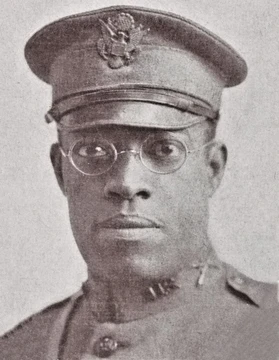
Ford Dabney
Last updated

via Wikipedia: Ford Dabney · see source
Ford Thompson Dabney (15 March 1883 – 6 June 1958) made his mark as an American ragtime pianist, composer, songwriter, and a highly regarded director of bands and orchestras for Broadway musicals, revues, vaudeville, and early recordings. He is most famous for writing both the music and lyrics to the 1910 tune "That's Why They Call Me Shine," a piece that became a lasting jazz standard and, by 2020, had been recorded 646 times within the jazz genre. Along with his frequent collaborator James Reese Europe, Dabney served as a bridge figure in the early development of jazz, helping move music from ragtime and blues into stride, boogie-woogie, and other advanced styles.
Career
Dabney got his start in Washington, D.C., attending the business education division of Colored High School (also called M Street High School) from ninth through eleventh grade, where Robert Heberton Terrell served as principal. On June 22, 1901, he moved up from first year to second year. He later enrolled at Armstrong Manual Training School in Washington. As a young man, he sang in the choir at St. Mary's Protestant Episcopal Chapel, a mission of St. John's Parish located on 23rd Street between G and H Streets, N.W., on what is now the George Washington University campus.
1901: New York
His private music studies began with his father John Wendell Dabney, then continued with his uncle Wendell Phillips Dabney, followed by Charles Donch, William Waldecker, and Samuel Fabian. Around 1901, Dabney relocated from Washington to New York, arriving two or three years ahead of James Reese Europe. In New York, he studied music and performed on piano in parlors and drawing rooms packed with high-society figures. Dabney and Europe frequently crossed paths at the Marshall Hotel in Midtown's Tenderloin District, located at 127–129 West 53rd Street between Sixth and Seventh Avenues, a hotel run by brothers James L. and George Marshall from 1901 to 1914 that catered to creative, intellectual black New Yorkers.
The Colored Vaudeville Benevolent Association set up its headquarters directly across the street at 320 West 53rd Street when it was founded in 1909. The Clef Club, which Dabney helped found in 1910 alongside Europe and others, first operated next door at 137 West 53rd Street before moving two blocks west to 334 West 53rd. One block east at 231 West 53rd stood St. Mark's M.E. Church, an African-American congregation active from 1895 to 1926. Just one block south, 52nd Street between 6th and 7th Avenues became famous for its dense cluster of jazz night clubs from the late 1930s through the early 1960s.
Works
Dabney's best-known piece, "That's Why They Call Me Shine," first appeared in S.H. Dudley's 1909 production His Honor the Barber, with a notable staging in 1911 at the Majestic Theater, now the site of the Time Warner Center. That production featured Dudley and Aida Overton Walker, who performed the song.
Dabney also contributed to the Ziegfeld Follies of 1910. With James Reese Europe, he co-wrote the Castle compositions, including "Castles' Half and Half" (1914), published by Joseph W. Stern in quintuple meter. Dabney also wrote The King's Quest (1909).
Professional affiliations
In April 1910, Dabney joined James Reese Europe, William Tyers, and Joe Jordan in forming the Clef Club, a union and booking agency that improved working conditions for black musicians in New York City. Around 1910, Dabney put together several touring vaudeville groups, including Dabney's Ginger Girls, a duet of Lottie Gee and Effie King that he created with violinist Willie Carroll; they debuted at his Washington, D.C., theater before hitting the road. Dabney, Europe, and others left the Clef Club and in 1913 organized the Tempo Club, an African American talent bureau that competed with the Clef Club and supplied an orchestra for the dance team of Irene and Vernon Castle.
Family
Ford Dabney was born to John Wesley Dabney, a celebrated barber and musician who cut hair for Presidents McKinley and Roosevelt, and Rebecca C. Ford. J.W. Dabney, often called Captain after joining the all-Black Washington Cadet Corps, later married Gertrude V. Adams, who sold his tonic products. Ford married Martha D. Gans, widow of legendary lightweight boxer Joe Gans, in 1912; they had a son, Ford Jr., who became a CPA. Ford’s uncle, James H. Dabney, a wealthy undertaker and philanthropist, married Ruby H. Adams.
Did You Know?
- Dabney owned and operated a theater bearing his name in Washington, D.C., from around October 1910 through 1911.
- Dabney's Syncopated Orchestra was the first black orchestra to play regularly in a Broadway theater, during Ziegfeld's Midnight Frolic from 1913 to 1921.
- In 1904, Dabney sailed to Haiti to serve as pianist to President Pierre Nord Alexis for a four-month post that was extended through 1907.
- Dabney's 1917 recording of "At the Darkdown Strutter's Ball" featured white vocalist Arthur Fields, an early interracial recording.
More in African-American Jazz Composers
Test yourself
Three questions drawn from this entry’s sources. Pick an answer to check it.
Answers checked against the source article
Sources
Compiled from Wikipedia and the sources listed below. Text from Wikipedia is available under CC BY-SA 4.0; this entry is adapted from it.
- Wikipedia: Ford Dabney (CC BY-SA 4.0).
Spotted an error? Know more?
Reader corrections go straight into our review queue. Suggest an edit · How this site is sourced