Kármán line
Conventional boundary between Earth's atmosphere and outer space.
Last updated
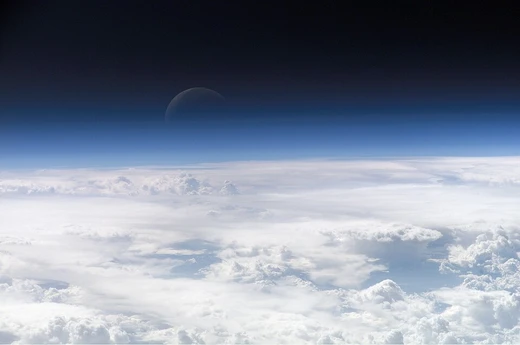
The Kármán line is a conventional definition of the edge of space, widely but not universally accepted. The FAI defines it at an altitude of 100 km above mean sea level. It is mainly used for legal and regulatory purposes to differentiate between aircraft and spacecraft.
Quick Facts
- Altitude (fai definition)
- 100 km (62.1 mi) above mean sea level
- Named after
- Theodore von Kármán
- Year established by fai
- 1960s
- Proposed alternative altitude (mcdowell
- 80 km / 49.7 mi
Facts from the source article.
Kármán's comments
In the final chapter of his autobiography, von Kármán addressed the edge of outer space. He noted that where space begins can be determined by the speed of a space vehicle and its altitude above Earth.
He cited the record flight of Captain Iven Carl Kincheloe Jr. in an X-2 rocket plane, who flew 2000 miles per hour at 126,000 feet, where aerodynamic lift still carried 98 percent of the weight. At 300,000 feet, this relationship is reversed because no air remains to contribute lift, only inertia prevails. Von Kármán considered this a physical boundary where aerodynamics stops and astronautics begins, and suggested it could also serve as a jurisdictional boundary, which Andrew G. Haley termed the Kármán Jurisdictional Line.
Technical considerations
No atmosphere ends abruptly; it becomes progressively less dense with altitude. Depending on how the various layers around Earth are defined, the edge of space could vary considerably, potentially extending to at least 10,000 km above sea level if the thermosphere and exosphere are considered part of the atmosphere. The Kármán line is a largely arbitrary definition based on technical considerations. An aircraft stays aloft by traveling forward relative to the air so wings generate aerodynamic lift; thinner air requires faster speed to generate enough lift.
At very high speeds, centrifugal force (Kepler force) contributes to maintaining altitude, which keeps satellites in circular orbit without aerodynamic lift. As altitude increases and air density decreases, the speed needed for aerodynamic lift increases until centrifugal force dominates, and the aircraft becomes an orbiting spacecraft. In 1956, von Kármán presented a paper on aerothermal limits to flight, calculating speeds and altitudes at which continuous flight was possible without overheating.
His chart included an inflection point at around 275,000 ft, above which an aircraft's structure would fail due to frictional heating, based on then-current materials.
Alternatives to the FAI definition
The U.S. military considers someone an astronaut if they have flown above 50 miles, which is roughly where the mesosphere meets the thermosphere. NASA once used the 100-kilometer mark set by the FAI, but in 2005 it changed its rule to avoid discrepancies between military and civilian crew members on the same flight. Three former NASA X-15 pilots—John B. McKay, William H. Dana, and Joseph Albert Walker—were later given astronaut wings, two of them after their deaths, for flights between 90 and 108 kilometers in the 1960s.
Walker reached the higher altitude twice, which is above the current international space boundary. The U.S. Federal Aviation Administration also uses this line. In 2018, researchers Jonathan McDowell and Thomas Gangale argued that space should start at 80 kilometers, pointing to von Kármán’s original notes, the fact that objects in orbit can survive several passes at 80 to 90 kilometers, and various functional, cultural, and technical reasons. This led the FAI to suggest a joint meeting with the International Astronautical Federation in 2019 to discuss the matter.
Another legal definition, adopted by the U.S. military, sets the lower edge of space as the lowest point an orbiting vehicle can reach, without giving a specific altitude. Because of atmospheric drag, the lowest altitude for a circular orbit to make one full loop without thrust is about 150 kilometers.
Did You Know?
- Scientists have estimated Kármán line equivalents for Mars (80 km by Isidoro Martínez, 113 km by Nicolas Bérend) and Venus (250 km by Martínez, 303 km by Bérend).
- In 2014, Oscar Sharp directed a British short film titled The Kármán Line, starring Olivia Colman as a woman who levitates and crosses the line into outer space.
More in Aerospace
Sources
Compiled from Wikipedia and the sources listed below. Text from Wikipedia is available under CC BY-SA 4.0; this entry is adapted from it.
- Wikipedia: Kármán line (CC BY-SA 4.0).
Spotted an error? Know more?
Reader corrections go straight into our review queue. Suggest an edit · How this site is sourced