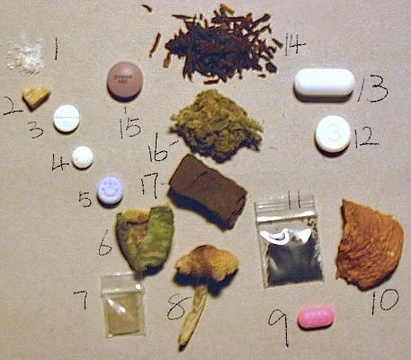
Hallucinogen
A diverse class of drugs inducing altered perception and mood.

Hallucinogens are a broad category of psychoactive substances that alter consciousness, leading to significant shifts in perception, mood, thinking, and the sense of self. They are sometimes called psychedelics, entheogens, or, historically, psychotomimetics. While often grouped into three main types—psychedelics, dissociatives, and deliriants—some hallucinogens don't fit neatly into any of these categories.
Examples of hallucinogens include psychedelics (like LSD, psilocybin, mescaline, and DMT), dissociatives (such as ketamine, PCP, DXM, and nitrous oxide), and deliriants (like scopolamine, diphenhydramine, and trihexyphenidyl). Others work through different mechanisms, including κ-opioid receptor agonists (salvinorin A, pentazocine, levorphanol), GABAA receptor agonists (muscimol, gaboxadol), oneirogens (ibogaine, harmaline), and cannabinoids (THC, nabilone, JWH-018). Additional substances like carbogen, hallucinogenic bolete mushrooms, and nutmeg are also considered hallucinogens.
To define a drug as hallucinogenic, Leo Hollister proposed five criteria: changes in thought, perception, and mood should dominate over other effects; memory or intellectual impairment should be minimal; stupor, narcosis, or excessive stimulation shouldn't be central; autonomic nervous system side effects should be minor; and addictive craving should be absent. Richard Glennon added two more criteria specifically for classical hallucinogens: they must bind to 5-HT2 serotonin receptors and be recognized by animals trained to discriminate the drug DOM.
Most hallucinogens are categorized by their pharmacology: psychedelics are serotonergic, dissociatives are generally antiglutamatergic, and deliriants are generally anticholinergic. However, some, like salvinorin A and ibogaine, don't fit these categories. Entactogens and cannabinoids are sometimes included as hallucinogens as well. The term "hallucinogen" can refer to this broad class or, in some contexts, only to classical hallucinogens (psychedelics), so it's important to check the definition used. Because the subjective effects are so varied, no standardized terminology based on experience has been widely accepted.
Classical hallucinogens have gone by many names. As David E. Nichols noted in 2004, earlier terms included "phantastica," while "hallucinogen," "psychotomimetic," and "psychedelic" have been used interchangeably. "Hallucinogen" is most common in scientific literature, though it's an inaccurate description of the actual effects. In the lay press, "psychedelic" remains popular. More recently, "entheogen" (from Greek, meaning "god within") has gained traction in counterculture and media, suggesting these substances connect users to a divine inner experience. Robin Carhart-Harris and Guy Goodwin argue that "psychedelic" is preferable to "hallucinogen" for classical psychedelics, since the latter misleadingly emphasizes hallucinations. Nichols disagrees, reserving "psychedelic" for serotonergic psychedelics specifically. Some hallucinogens are designer drugs, like those in the 2C and 25-NB (NBOMe) families, which are structural or functional analogs of controlled substances designed to mimic effects while avoiding legal classification or detection.
Different classes produce different effects. Psychedelics, or serotonergic classical hallucinogens, act as 5-HT2A receptor agonists. Despite attempts since the 19th and 20th centuries to define common patterns of experience, no universally accepted taxonomy for their effects exists.
- types
- Psychedelics, dissociatives, deliriants, κ-opioid receptor agonists, GABAA receptor agonists, oneirogens, others
- examples
- LSD, psilocybin, mescaline, DMT, ketamine, PCP, DXM, nitrous oxide, scopolamine, diphenhydramine, salvinorin A, ibogaine
- classification_criteria
- Hollister's five criteria; Glennon's two additional criteria for classical hallucinogens
- common_mechanisms
- 5-HT2A receptor agonism, NMDA receptor antagonism, antimuscarinic activity, κ-opioid receptor agonism, GABAA receptor agonism
Quick Facts
- Use
- Recreational, spiritual, medical
- Mechanism Of Action
- Various
- Legal Status
- Variable
Facts from the source article.
Lore & Background
Hallucinogens are a broad class of psychoactive drugs that induce altered states of consciousness, with changes in perception, mood, cognition, and self-experience. They are often categorized as psychedelics (5-HT2A receptor agonists), dissociatives (NMDA receptor antagonists), or deliriants (antimuscarinics), though some, like salvinorin A and ibogaine, do not fit these categories. Leo Hollister gave five criteria for classifying a drug as hallucinogenic, including that changes in thought, perception, and mood should predominate, and addictive craving should be absent. Richard Glennon added two criteria for classical hallucinogens: binding at 5-HT2 serotonin receptors and recognition by animals trained to discriminate the drug DOM.
Reader's Guide
Hallucinogens have been described by many names, including phantastica, psychotomimetic, psychedelic, and entheogen. The term hallucinogen is the most common in scientific literature, though some argue it misleadingly emphasizes hallucinogenic properties. Psychedelics, or classical hallucinogens, are serotonin 5-HT2A receptor agonists and often produce visual alterations, including geometric patterns, and can trigger mystical experiences as measured by psychometric scales. Different classes have different mechanisms and effects: dissociatives act on NMDA receptors, deliriants on muscarinic receptors, and others on κ-opioid or GABAA receptors. Efforts to create standardized terminology for classifying hallucinogens based on subjective effects have not succeeded. Designer drugs, such as those in the 2C and 25-NB families, are structural or functional analogs designed to mimic pharmacological effects while avoiding legal classification.
Did You Know?
- Hallucinogens are often categorized as psychedelics, dissociatives, or deliriants, but not all fall into these three classes.
- Leo Hollister gave five criteria for classifying a drug as hallucinogenic, including minimal intellectual impairment and absence of addictive craving.
- Classical hallucinogens must bind at 5-HT2 serotonin receptors and be recognized by animals trained to discriminate the drug DOM.
- The term entheogen, meaning 'god within,' has seen increasing use in popular media and counterculture.
More in Addictive Substances & Medications 1-24
Spotted an error? Know more?
This is a living reference — every entry is fact-audited, and reader corrections feed straight into our audit queue. Suggest an edit · See this site's audit record