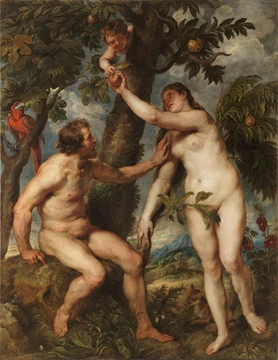
Adam in rabbinic literature
Rabbinic literature expands Adam's creation, fall, and future role.
Allusions in rabbinic literature to the Biblical figure Adam, created according to the Book of Genesis by God in the Garden of Eden as the first man, expand and elaborate and draw inferences from what is presented in the text of the Bible itself.
Quick Facts
- Lifespan
- 930 years
- Acrostic of name
- אפר
- דם
- מרה (ashes, blood, gall)
- Psalms ascribed to adam
- 5, 19, 24, 92
Facts from the source article.
As representative of mankind
Simeon ben Azzai, in a dispute with Rabbi Akiva over the fundamental principle of the Law, maintained that the Golden Rule (Leviticus 19:18) must be based on the verse teaching that all men are offspring of him made in God's image. This emphasizes Adam's typical character as the representative of the unity of mankind.
Adam's creation
The dust used to form Adam was taken from the site of the Temple in Jerusalem and from the four corners of the world, then mixed with water from every sea, producing a being of red, black, and white. Rabbi Johanan bar Nappaha read Adam’s name as an acrostic for ashes, blood, and gall. Rabbi Meir taught that the dust was gathered from the entire world, while Abba Arikha specified that Adam’s head came from the Holy Land, his torso from Babylonia, and his other limbs from various lands.
The two biblical creation accounts reflect two views of human nature, which the aggadah sharpens. Both heaven and earth were meant to share in making humanity, so God consulted the angelic host when he said, “Let us make man.” Before sin, Adam’s body stretched from earth to heaven, or from one end of the world to the other. He possessed extreme beauty and a brightness like the sun; his skin was a shining garment, bright as his nails.
When he sinned, that radiance vanished, leaving him naked. When God proposed making man in his image, the angels grew jealous and protested, calling humanity a creature of falsehood, hatred, and strife. But Love argued for him, and God declared, “Let truth spring forth from the earth.” One midrashic legend says the angels, awestruck by Adam as God’s image, wanted to worship him and cry “Holy!”
Instead, God put Adam into a deep sleep, making him lie like a corpse, and quoted Isaiah: “Cease ye from man, whose breath is in his nostrils.” Another version holds that all other creatures bowed before Adam, mistaking him for their creator, but he pointed upward to God and recited, “The Lord reigneth, He is clothed with majesty.”
The Fall
Before his transgression, Adam dwelled in paradise attended by angels who danced before him and served him food called "angel's bread." Every creature bowed to him in awe, and he was the light of the world. But sin stripped him of all glory. The earth and the heavenly bodies dimmed, a brightness that will only return in the Messianic age. Death entered the world for Adam and all creation. Because a divine day equals a thousand years, Adam lived 930 years—70 years short of a thousand—so that the warning "in the day that thou eatest thereof, thou shalt surely die" held true. After the fall, animals no longer respected man as their ruler; they attacked him. The serpent's poison still affects every generation, unless released by the covenant at Sinai.
Yet repentance can undo sin's deadly effect. Adam thus became a model penitent. He underwent a harsh ordeal: fasting, praying, and bathing in a river for 47 days (seven weeks, according to Pirke de Rabbi Eliezer), or perhaps twice that. When the days shortened after Tishri, Adam saw it as God's anger, but after the winter solstice the days lengthened again, and he offered a thanksgiving sacrifice. Another tradition says he gave thanks at the next sunrise, with angels joining him in singing Psalm 92, the Sabbath psalm. Because of the Sabbath, the sun kept its brightness for that day, but when darkness fell Adam was terrified, remembering his sin. God then taught him to make fire by striking stones, and ever since, fire is blessed at the close of each Sabbath.
When Adam heard the curse "Thou shalt eat of the herbs of the earth," he was horrified, asking, "Must I and my ass eat from the same trough?" God reassured him: "With the sweat of thy brow shalt thou eat bread," showing comfort in work. Angels taught Adam farming, all trades, and ironworking. Writing was also credited to him. The garments God made for Adam were not of skin (עור) but of light (אור), and robes of glory were fashioned from the serpent's skin.
Adam in the Future World
Adam is said to have been the first person given the promise of resurrection. Rabbi Ammi explained the Jewish perspective on his sin: no one dies except for their own wrongdoing. When the righteous, who are allowed to see the divine presence before death, pass Adam at the gate and blame him for bringing mortality, he responds that he died for a single sin, while they die for many of their own. Several psalms are attributed to Adam: Psalms 5, 19, 24, and 92. The rabbis also held that Adam was formed from the very dust where the sanctuary would later be built to atone for all human sin. This was meant to show that sin is not a permanent or inborn part of human nature.
More in Adam and Eve
Spotted an error? Know more?
Reader corrections go straight into our review queue. Suggest an edit · How this site is sourced