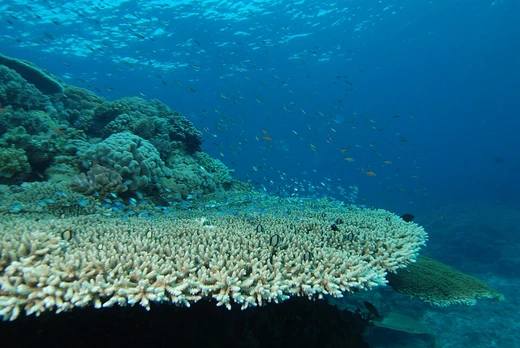
Acropora polystoma
An endangered acroporid coral of strong-wave reef slopes.
Last updated

MDC Seamarc Maldives · via Wikipedia: Acropora polystoma · CC BY-SA 4.0
Acropora polystoma is a colonial coral that forms clumps or corymbose plates up to 80 cm across.[1] G. Brook originally named this coral Madrepora polystoma in 1891.[2] The IUCN Red List categorizes this species as endangered, and it appears in CITES Appendix II.[3]
Scientific classification
- KingdomAnimalia
- PhylumCnidaria
- SubphylumAnthozoa
- ClassHexacorallia
- OrderScleractinia
- FamilyAcroporidae
- GenusAcropora
- SpeciesAcropora polystoma
Named by (Brook, 1891)
Close relatives
Other species of Acropora with a Codexery entry.
- Acropora abrotanoides Acropora abrotanoides
- Acropora aculeus Acropora aculeus
- Acropora acuminata Acropora acuminata
- Acropora arabensis Acropora arabensis
- Acropora aspera Acropora aspera
- Acropora awi Acropora awi
- Acropora batunai Acropora batunai
- Acropora caroliniana Acropora caroliniana
Sources: Wikipedia taxobox: Acropora polystoma (CC BY-SA 4.0) · order, family and genus agree with WoRMS AphiaID 207050 (CC BY 4.0)
Conservation status
Endangered (EN)
- LC
- NT
- VU
- EN▲ this species
- CR
- EW
- EX
Source: IUCN Red List assessment · GBIF copy of the Red List category
How big is it?
Largest length in the source, 0.1 m, next to a 1.8 m person.
Diagram: drawn by Codexery, schematic shapes to scale (not a likeness). Length: Wikipedia: Acropora polystoma
Where the acropora polystoma has been recorded
Each dot is a place where the species has been observed and reported (317 records, half-degree grid) — not a modelled range. 8 inland records left out (institution coordinates).
Map: drawn by Codexery. Data: GBIF occurrence search (records CC0 / CC BY) · Natural Earth basemap (public domain)
Biology and range
Colonies are blue, cream, yellow, lavender, or brown.[1] Radial corallites are tube-shaped and arranged in regular rows.[4] Branchlets can grow up to 100 mm long and have diameters ranging from 5 to 15 mm, tapering as they approach the tips.[1] Aragonite, a form of calcium carbonate, makes up the skeleton.[5]
This coral inhabits shallow tropical marine reefs at depths of 3 to 10 m.[4] The species is found on reef edges and on slopes where strong waves have caused damage.[5] In French Polynesia, Acropora polystoma undergoes spawning during October.[3]
What the specialist sources record
The World Register of Marine Species accepts Acropora polystoma (Brook, 1891) in the family Acroporidae, order Scleractinia.[6] GBIF accepts the species and holds 392 occurrence records as of 7 October 2026.[7] The Australian Institute of Marine Science and Wallace's 1999 revision provide the morphological description of the species.[1][4]
References
- Wikipedia, "Acropora polystoma" (CC BY-SA 4.0), which cites: "Acropora polystoma Fact Sheet. (Brook, 1891)", Australian Institute of Marine Science; Wallace, "Staghorn Corals of the World: A Revision of the Genus Acropora", Csiro Publishing, 1 September 1999, p. 73; Wallace, "Staghorn Corals of the World: A Revision of the Genus Acropora", Csiro Publishing, 1 September 1999, p. 73; "Acropora polystoma Fact Sheet. (Brook, 1891)", Australian Institute of Marine Science; Wallace, "Staghorn Corals of the World: A Revision of the Genus Acropora", Csiro Publishing, 1 September 1999, p. 73 (original en.wikipedia.org
- Wikipedia, "Acropora polystoma" (CC BY-SA 4.0), which cites: "Acropora polystoma", World Register of Marine Species (original not read by us) en.wikipedia.org
- Wikipedia, "Acropora polystoma" (CC BY-SA 4.0), which cites: Nuñez Lendo, C.I., "Acropora polystoma", 2024 (original not read by us) en.wikipedia.org
- Wikipedia, "Acropora polystoma" (CC BY-SA 4.0), which cites: "Acropora polystoma Fact Sheet. (Brook, 1891)", Australian Institute of Marine Science; Wallace, "Staghorn Corals of the World: A Revision of the Genus Acropora", Csiro Publishing, 1 September 1999, p. 73; "Acropora polystoma Fact Sheet. (Brook, 1891)", Australian Institute of Marine Science; Wallace, "Staghorn Corals of the World: A Revision of the Genus Acropora", Csiro Publishing, 1 September 1999, p. 73; "Acropora polystoma Fact Sheet. (Brook, 1891)", Australian Institute of Marine Science; Wallace, "Staghorn Corals of the World: en.wikipedia.org
- Wikipedia, "Acropora polystoma" (CC BY-SA 4.0), which cites: Nuñez Lendo, C.I., "Acropora polystoma", 2024; "Measurements and facts about Acropora polystoma", Encyclopedia of Life (original not read by us) en.wikipedia.org
- World Register of Marine Species, Acropora polystoma (AphiaID 207050). CC BY 4.0. marinespecies.org
- GBIF Backbone Taxonomy and occurrence index, Acropora polystoma (taxon key 5184667). CC BY 4.0 (backbone); counts are facts. gbif.org
Each numbered sentence above was checked against the source it cites before publication. Sentences citing Wikipedia adapt text from the English Wikipedia article Acropora polystoma (contributors), used under CC BY-SA 4.0; this entry is available under the same licence. Other sources were used for facts only; no text or images are copied from them.
More in Acropora Corals
Sources
Compiled from Wikipedia and the sources listed below. Text from Wikipedia is available under CC BY-SA 4.0; this entry is adapted from it.
- Wikipedia: Acropora polystoma (CC BY-SA 4.0).
- Classification: the source article's taxobox; order, family and genus checked against WoRMS, the World Register of Marine Species (CC BY 4.0).
- Conservation status: IUCN Red List assessment.
- Occurrence records: GBIF (CC0 / CC BY). Basemap: Natural Earth (public domain).
- Word definitions: the , each quoted from its Wikipedia article.
Spotted an error? Know more?
Reader corrections go straight into our review queue. Suggest an edit · How this site is sourced