Frequently Asked Questions
The most-asked questions about acropora corals, part 2.
What does 'Acropora Part 2' of the fan encyclopedia actually cover?
Part 2 dives deeper into the Acropora genus than Part 1, focusing on species-level taxonomy, reef ecology, and the conservation challenges these stony corals face today. It is an unofficial, community-written reference rather than a peer-reviewed text.
Who are the main taxonomic figures fans keep citing in Part 2?
The encyclopedia repeatedly references early workers like Dana (1846) who first described the genus, and modern systematists such as Veron and Pugh whose 2000s revisions reshaped how species are split and named. Their taxonomic decisions drive most of the species profiles in this section.
Where should a total newcomer to Acropora start reading?
The editors recommend beginning with the 'Colony Morphology' overview page, then moving to the 'Growth Forms' comparison chart before tackling individual species entries. That sequence builds the visual vocabulary you need to follow the more technical taxonomy pages.
How many Acropora species does Part 2 profile, and why that number?
Part 2 profiles roughly 140 described species, a figure that shifts as the Veron-and-Pugh framework is periodically updated. The editors note that the exact count is debated because some 'species' may be cryptic complexes awaiting genetic confirmation.
What single trait defines Acropora and sets it apart from other Scleractinia?
Acropora is distinguished by its highly branched, rapidly growing colonies built around a central axial corallite surrounded by a ring of radial corallites. This architecture lets them outpace most other reef builders in vertical and lateral extension.
What is considered a 'notable moment' in Acropora research history?
Fans often point to the 1846 description by James Dwight Dana as the foundational event, but the 2002 Veron & Pugh monograph is treated as the modern turning point because it collapsed and re-split dozens of species groups. Both are given dedicated timeline entries in Part 2.
Where in the world do Acropora corals occur?
They are found across the shallow tropical waters of the Indo-Pacific, from the Red Sea and East Africa eastward to the central Pacific and south to northern Australia. The encyclopedia notes they are essentially absent from the Atlantic and very rare in the Caribbean.
What misconception about Acropora does the fan community push back on most?
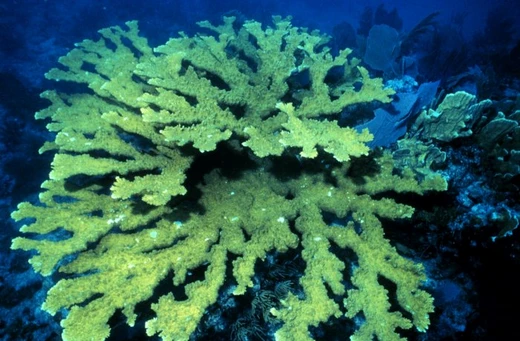
A persistent myth is that all Acropora are 'staghorn' corals; Part 2 clarifies that the genus includes plate, boulder, and encrusting forms alongside the familiar branching types. The 'staghorn' label properly applies only to a subset of branching species.
What are the biggest threats to Acropora populations highlighted in Part 2?
Thermal stress leading to mass bleaching is treated as the primary acute threat, followed by sedimentation, ocean acidification, and physical damage from storms or anchoring. The conservation pages stress that Acropora's fast growth is a double-edged sword because it also makes colonies vulnerable to rapid mortality events.
Is Part 2 a standalone document, or do I need Part 1 first?
Part 2 assumes familiarity with basic coral biology and the higher-level taxonomy introduced in Part 1, so the editors advise reading Part 1's introductory chapters first. That said, each species page in Part 2 is written to be largely self-contained for a reader who already knows what a scleractinian coral is.