Oxonium ion
Cations with trivalent oxygen, key in organic synthesis and biosynthesis.
An oxonium ion is a positively charged ion where an oxygen atom forms three bonds and carries a +1 formal charge. The hydronium ion (H₃O⁺) is the simplest example.
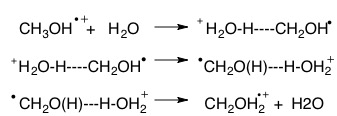
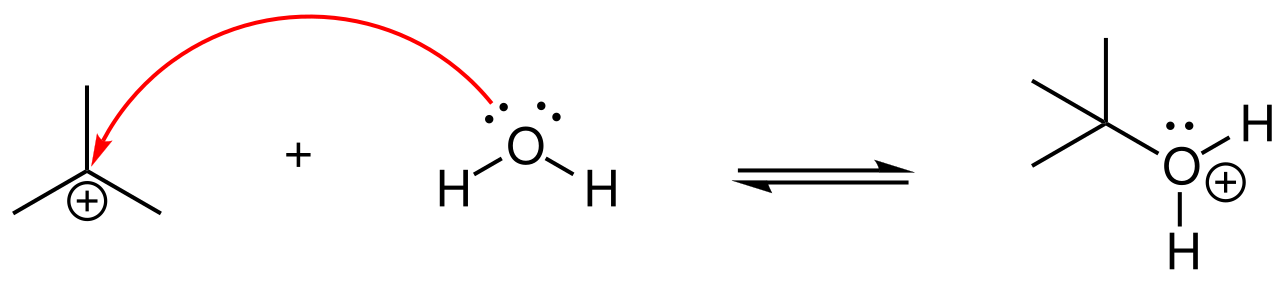
Oxonium ions can be classified by the number of alkyl groups attached. Primary oxonium ions have the formula ROH₂⁺, such as methyloxonium (CH₃OH₂⁺) from protonated methanol. In acidic conditions, this oxonium group can act as a leaving group in E2 elimination, producing an alkene, though this usually requires strong acid, heat, and dehydrating conditions. Secondary oxonium ions have the formula R₂OH⁺, like dimethyloxonium ((CH₃)₂OH⁺) from protonated dimethyl ether. Tertiary oxonium ions have the formula R₃O⁺, such as trimethyloxonium ((CH₃)₃O⁺). Tertiary alkyloxonium salts, like triethyloxonium tetrafluoroborate, are useful alkylating agents for making ethyl esters when Fischer esterification is impractical, and also for preparing enol ethers and related groups.
Unusually stable oxonium ions include oxatriquinane and oxatriquinacene, first reported in 2008. Oxatriquinane does not react with boiling water, alcohols, thiols, halide ions, or amines, but does react with stronger nucleophiles like hydroxide, cyanide, and azide.
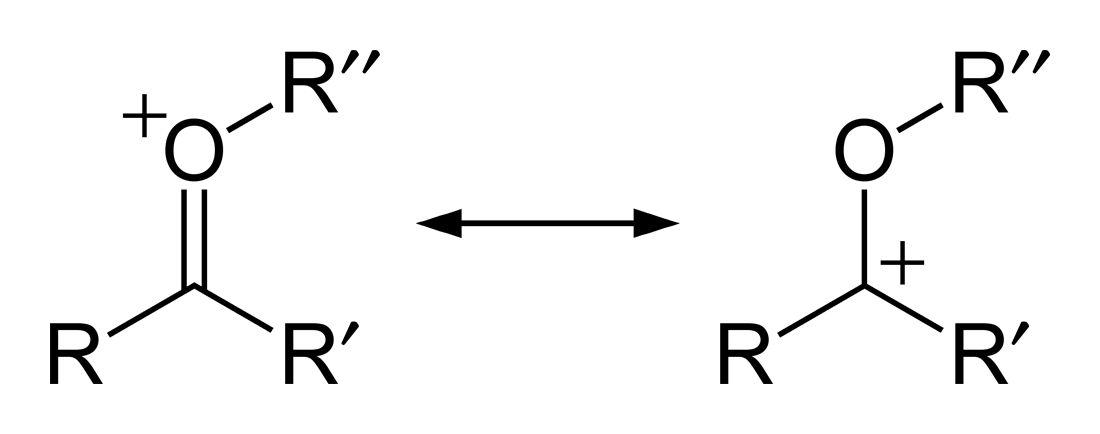
Another class is the oxocarbenium ions, formed by protonating or alkylating a carbonyl group. These have a resonance structure with a carbocation, making them especially stable.
A gold-stabilized oxonium species, tris[triphenylphosphinegold(I)]oxonium tetrafluoroborate, is stabilized by aurophilic interactions between gold atoms. It is made from Ph₃PAuCl, Ag₂O, and NaBF₄, and has been used as a catalyst for the propargyl Claisen rearrangement.
In natural product chemistry, complex bicyclic and tricyclic oxonium ions have been proposed as key intermediates in the biosynthesis of compounds from red algae of the genus *Laurencia*. Several of these ions have been synthesized using a weakly coordinating anion (Krossing’s anion) as the counterion. This was achieved by reacting an organic halide precursor with the silver salt of the anion, causing halide abstraction and precipitation of silver halides. The resulting oxonium ions were characterized by NMR at −78 °C and supported by DFT calculations. These ions were shown to directly produce several related natural products when reacted with nucleophiles like water, bromide, chloride, and acetate.
- field
- Chemistry
- known_for
- Cations with trivalent oxygen and +1 charge; includes hydronium, alkyloxonium, oxocarbenium, and gold-stabilized species
- subtypes
- Hydronium, primary oxonium (ROH+2), secondary oxonium (R2OH+), tertiary oxonium (R3O+), oxocarbenium ions
- notable_examples
- Trimethyloxonium, triethyloxonium tetrafluoroborate, oxatriquinane, oxatriquinacene, [(Ph3PAu)3O]+[BF4]−
Lore & Background
Oxonium ions are cations characterized by an oxygen atom with three bonds and a formal positive charge. The oxygen atom in these ions typically adopts a pyramidal geometry due to sp³ hybridization. The simplest oxonium ion is the hydronium ion (H₃O⁺). A general series of oxonium ions follows the formula RₙH₃₋ₙO⁺, where R represents an alkyl group. Primary oxonium ions (n=1) are formed by protonating an alcohol, such as protonated methanol, known as methyloxonium. Secondary oxonium ions (n=2) arise from protonating ethers, for example, protonated dimethyl ether, called dimethyloxonium. Tertiary oxonium ions (n=3) include trimethyloxonium. Tertiary alkyloxonium salts serve as effective alkylating agents; triethyloxonium tetrafluoroborate is a white crystalline solid used to produce ethyl esters and enol ethers when standard methods are unsuitable. Unusually stable oxonium ions, such as oxatriquinane and oxatriquinacene, were first described in 2008. Oxatriquinane does not react with boiling water, alcohols, thiols, halide ions, or amines, but it does react with stronger nucleophiles like hydroxide, cyanide, and azide. Another class is the oxocarbenium ions, obtained by protonating or alkylating a carbonyl group, which are stabilized by resonance with a carbocation form. A gold-stabilized oxonium species, tris[triphenylphosphinegold(I)]oxonium tetrafluoroborate, is stabilized by aurophilic interactions between gold atoms and is used as a catalyst for the propargyl Claisen rearrangement. Complex bicyclic and tricyclic oxonium ions have been proposed as key intermediates in the biosynthesis of natural products from red algae of the genus *Laurencia*. These elusive species have been prepared by total synthesis using a weakly coordinating anion, such as Krossing's anion, and characterized by nuclear magnetic resonance spectroscopy at low temperature with support from density functional theory computations.
Reader's Guide
Oxonium ions are fundamental in organic chemistry as reactive intermediates and reagents. The hydronium ion is the simplest example, but alkyloxonium ions—primary, secondary, and tertiary—play distinct roles: primary oxonium ions facilitate elimination reactions to form alkenes, while tertiary oxonium salts like triethyloxonium tetrafluoroborate serve as powerful alkylating agents under conditions where traditional methods fail. Oxocarbenium ions, another subclass, are stabilized by resonance and are common in carbonyl chemistry. Gold-stabilized oxonium species demonstrate the influence of aurophilic interactions on cation stability and have catalytic applications. In natural product chemistry, complex oxonium ions are proposed intermediates in the biosynthesis of Laurencia-derived compounds, and their synthetic generation using weakly coordinating anions has confirmed their existence and reactivity. Overall, oxonium ions bridge fundamental cation chemistry with practical synthetic and biological contexts.
Did You Know?
- The simplest oxonium ion is the hydronium ion (H3O+).
- Triethyloxonium tetrafluoroborate is a white crystalline solid used as an alkylating agent.
- Oxatriquinane does not react with boiling water, alcohols, thiols, or halide ions, but it does react with amines.
- Complex oxonium ions have been proposed as key intermediates in the biosynthesis of natural products by red algae of the genus Laurencia.
Gallery

Frequently Asked Questions
Who is Oxonium ion?
Oxonium ion is a broad family of cationic species defined by an oxygen atom carrying three bonds and a +1 formal charge. The most basic member of this family is the hydronium ion (H3O+), while others include alkyloxonium, oxocarbenium, and even gold-stabilized variants.
What are Oxonium ion's powers and role?
In organic chemistry, oxonium ions act as reactive intermediates in alkylation reactions and appear in substitution and elimination pathways. They are also central to biosynthetic processes, making them essential players in both laboratory synthesis and natural-product formation.
How does Oxonium ion's story end?
Because oxonium ions are typically intermediates rather than final products, their arc usually concludes when a nucleophile or base attacks the positively charged oxygen, breaking a C–O or O–H bond and yielding a neutral product. In aqueous acid-base equilibria, hydronium simply transfers a proton to a base and reverts to plain water.
Why is Oxonium ion important?
Oxonium ions sit at the heart of countless organic transformations, from simple proton transfers to complex multistep syntheses. Practical reagents like trimethyloxonium and triethyloxonium tetrafluoroborate serve as methylating and ethylating agents, while larger frameworks such as oxatriquinane showcase the family's remarkable structural diversity.
What are Oxonium ion's family members?
The family spans hydronium, primary (ROH2+), secondary (R2OH+), and tertiary (R3O+) oxonium ions, plus the oxocarbenium subfamily. Exotic relatives include gold-stabilized species like [(Ph3PAu)3O]+[BF4]− and polycyclic members such as oxatriquinacene.
More in Acids And Bases 1-24
Spotted an error? Know more?
This is a living reference — every entry is fact-audited, and reader corrections feed straight into our audit queue. Suggest an edit · See this site's audit record