Jack and the Beanstalk (1952 film)
Last updated
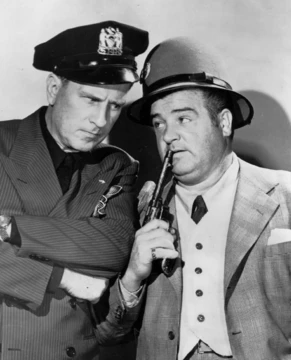
In 1952, the fantasy comedy film Jack and the Beanstalk was released, starring Abbott and Costello alongside Buddy Baer, Dorothy Ford, and Barbara Brown. Its screenplay humorously adapts the classic fairy tale.
Plot
An employment agency sends Mr. Dinkle and Jack Strong to babysit a bratty boy named Donald. They try reading him the fairy tale, but Jack trips over the big words, so Donald takes over. Jack dozes off and dreams he is the story's young Jack. In this dream, a giant has stolen all the kingdom's food and the crown jewels.
The princess is forced to marry a prince from a faraway land she has never met. Jack's mother orders him to sell their beloved cow, Henry, to the butcher, Mr. Dinklepuss. On the way, Jack meets the prince disguised as a troubadour, who is soon snatched by the giant. The shady Dinklepuss trades five magic beans for the cow.
Jack then discovers the giant has also kidnapped the princess and Henry. His exasperated mother tells him to plant the beans, and a giant beanstalk sprouts overnight. Jack climbs it to rescue everyone and reclaim Nellie, a hen the giant had taken from his family. Dinklepuss tags along, and they are both captured and locked up with the prince and princess.
The princess falls for the troubadour, only to realize he is her betrothed prince. The giant lets Jack and Dinklepuss out to work. Jack mixes gunpowder into the chicken feed, making the giant's omelette explode. They befriend the housekeeper Polly, who helps them escape over the castle wall with the prisoners, Nellie, and some stolen gems.
They scramble down the beanstalk as the giant chases them. During the descent, Dinklepuss drops Nellie, who lands in Jack's mother's arms, and the gems shower the poor townsfolk below. Once everyone is on the ground, Jack chops the beanstalk, and the giant falls to his death. The villagers celebrate by dancing around the hole he left.
Just as the king is about to reward Jack, Donald smashes a vase over his head, waking him. A second whack from Dinkle sends Jack back into his dream.
Production
Lou Costello came up with the idea for this film to win over younger audiences and push back against the charge that he and Bud Abbott were simply rehashing old material. The fairy tale had been adapted as a feature just once before, in a 1917 silent film. The duo looked into the story and turned up at least five different versions, giving them plenty of fresh angles. When Universal-International would not pay for color filming, Abbott and Costello—whose contract let them make one independent picture a year—bankrolled it through Costello’s own Exclusive Productions.
Warner Bros. handled distribution but put up no money or production help. Shooting ran from July 9 to August 2, 1951, at Hal Roach Studios, using sets left over from Joan of Arc (1948).
Before the movie came out, the pair trimmed over 26 minutes, representing $50,000 in footage, because some scenes had slipped back into their old, worn-out jokes. The opening and closing parts are in sepia tone, though many DVD versions show them in black-and-white. The main story was shot in Eastmancolor and released using the SuperCinecolor process.
Reception
Oscar Godbout of the New York Times said the film focuses on the pratfalls and chaos Abbott and Costello create. He observed their slapstick style has not been greatly refined, but their story choice is a clear improvement. Though the movie falls short of distinguished slapstick comedy, Godbout gave them credit for abandoning dull, pointless routines and silly plots. He encouraged them to keep going.
Did You Know?
- RKO attempted to renew the film's copyright in 1980, but as it was first copyrighted in 1951, the renewal should have occurred in 1979, causing the film to enter the public domain.
- A 2020 Kickstarter campaign to fund a Blu-ray restoration reached its $7,500 goal in two hours.
- ClassicFlix released a restoration on Blu-ray and DVD on July 26, 2022 in commemoration of the film's 70th anniversary.
More in Abbott and Costello Films
Sources
Compiled from Wikipedia and the sources listed below. Text from Wikipedia is available under CC BY-SA 4.0; this entry is adapted from it.
- Wikipedia: Jack and the Beanstalk (1952 film) (CC BY-SA 4.0).
Spotted an error? Know more?
Reader corrections go straight into our review queue. Suggest an edit · How this site is sourced