Digital puppetry
Real-time performance of digital characters using puppetry techniques.
Last updated
Digital puppetry involves controlling digital 2D or 3D characters and objects in real time within a computer-generated environment. It appears most often in film and TV, but also in theme park attractions and live theater. Unlike traditional frame-by-frame animation, it relies on live performance.
The exact boundaries of the term are debated by puppeteers and computer graphics designers. It is linked to character animation, motion capture, 3D animation, and skeletal animation, and is also called virtual puppetry, performance animation, or real-time animation. Machinima is another form.
History and usage
Lee Harrison III conducted early experiments in the 1960s, using analog circuits and a cathode ray tube to animate figures. He created a body suit with potentiometers, forming the first working motion capture rig, and produced short films with his system called ANIMAC. One character, Mr. Computer Image, was controlled by the body rig and an early voice-controlled automatic lip sync. The first live performance of a digital 3D character for an audience was Mike the Talking Head, developed by Brad DeGraf and Michael Wahrman, unveiled at the 1988 SIGGRAPH convention.
It was driven by a controller allowing a single puppeteer to control facial parameters. The system later created the villain Cain in RoboCop 2, the first use of digital puppetry in a full-length motion picture. Waldo C. Graphic, created in 1988 by Jim Henson and Pacific Data Images for The Jim Henson Hour, was the first real-time digital 3D puppet used commercially in a broadcast television series and a major theme park attraction. Henson had earlier used the Scanimate system for a digital version of his Nobody character on Sesame Street in 1970, and Waldo grew from experiments to create a computer-generated Kermit the Frog in 1985.
Types of digital puppetry
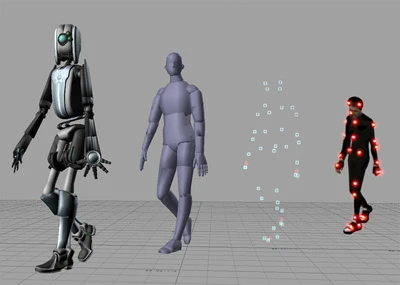
A digital puppet is controlled in real-time by a puppeteer using a telemetric input device called a Waldo, named after a story by Robert A. Heinlein. The device's X-Y-Z axis movement causes corresponding movement of the digital puppet. Alternatively, an object or human body serves as a physical representation, with its movements matched by the digital puppet in real time. Motion capture puppetry is commonly used by VTubers, who rig digital avatars to correspond to head movements using webcams or smartphones with 3D depth cameras.
More in 3D Computer Graphics
Sources
Compiled from Wikipedia and the sources listed below. Text from Wikipedia is available under CC BY-SA 4.0; this entry is adapted from it.
- Wikipedia: Digital puppetry (CC BY-SA 4.0).
Spotted an error? Know more?
Reader corrections go straight into our review queue. Suggest an edit · How this site is sourced