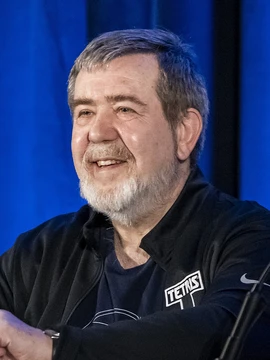
Sergey Goldin
Soviet and Russian geophysicist, academician, and earthquake forecasting theorist.
Last updated
Sergey Vasilyevich Goldin (28 January 1936 – 18 May 2007) was a Soviet and Russian geophysicist, Academician of RAS, member of European Academy of Science and American Geophysical Union, and director of the Institute of Geophysics in the Siberian Branch of RAS from 1996 to 2004. He completed secondary school in Vologda in 1953 with a silver medal and graduated with high distinction from the geophysical faculty of the Leningrad Mining Institute in 1958. Over his career, he authored more than 200 scientific publications, including four monographs, and taught at Novosibirsk State University from 1971, becoming a professor in 1983 and chair of geophysics in 1990.
Biography
Goldin's early career included three years in field geological parties in Kolpashevo, Surgut, and Berezovo (all in Siberia), where he participated in the opening of an oil deposit near Surgut. In 1961, he entered postgraduate study at the Institute of Geology and Geophysics SB of AS USSR, becoming a research assistant in 1964. He defended his PhD thesis in physical and mathematical sciences in 1966 on 'The Noise stability of algorithms of phase correlation of seismic waves against disturbances.'
In 1965, he moved to Tyumen to head the laboratory of mathematical processing at the Western-Siberian scientific-research geology-prospecting oil institute and began teaching at the Tyumen industrial institute. He returned to Novosibirsk in 1970 to head the laboratory of mathematical methods of geophysics at the Institute of Geology and Geophysics. He defended his doctoral thesis in 1979 on 'Kinematic interpretation of the reflected seismic waves (the theory and algorithms).'
He was elected a corresponding member of the AS USSR in 1991 and a full member of the Russian Academy of Sciences in 1997. He directed the Institute of Geophysics of the Siberian Branch of the Russian Academy of Sciences from 1996 to 2004. He died on 18 May 2007 after a serious illness and is buried at the Cherbuzinskoye Cemetery in Novosibirsk.
Scientific achievements
Goldin developed the theory of seismic migration, which allows quantitative comparison of various algorithms for constructing plots of the medium and synthesis of algorithms with set properties. In his later years, he studied nonlinear effects bound to diffusion of seismic waves in heterogeneous media, physical processes in the seismic source, and earthquake forecasting. In the early 2000s, he proposed a new concept of geophysical and geodynamic monitoring of seismically active regions, embodying a strategy for short-term earthquake forecasting that prioritized research into geomechanical and physical processes descending in concrete block massifs at the source location.
He also put forward geodynamic problems of physical processes in the seismic source before, during, and after an earthquake, describing accommodation processes that allow the medium 'to adapt (to any limen)' to increasing loads, involving repacking, quasiplastic flow, dilatant strengthening, and the phenomenon of dynamic convertibility of dilatancy, leading to formation of mesostructures in source areas. Among his pupils are three doctors and 25 holders of PhD of science.
More in 20th-century Russian Inventors
Test yourself
Three questions drawn from this entry’s sources. Pick an answer to check it.
Answers checked against the source article
Sources
Compiled from Wikipedia and the sources listed below. Text from Wikipedia is available under CC BY-SA 4.0; this entry is adapted from it.
- Wikipedia: Sergey Goldin (CC BY-SA 4.0).
Spotted an error? Know more?
Reader corrections go straight into our review queue. Suggest an edit · How this site is sourced