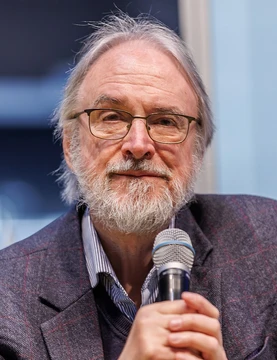
Konrad Johannes Karl Büttner
Last updated
Konrad Johannes Karl Büttner, a German-American meteorologist and bioclimatologist, taught at universities and studied heat transfer in bioclimatology, along with human thermal stress in aviation and space medicine.
Education
Büttner attended the Gymnasium high school at Schulpforte from 1917 to 1922. He then studied geophysics, physics and mathematics in Erlangen, Hanover and Göttingen from 1922 to 1926. In 1927 he completed a doctorate at the University of Göttingen with a thesis on experiments on penetrating radiation, earning a Dr. Phil. He completed his habilitation at the University of Kiel in 1934 with a treatise on heat transfer by conduction, convection, evaporation and radiation in bioclimatology and meteorology, and became head of the Bioclimatic Research Centre there.
University of Washington in Seattle
Konrad Johannes Karl Büttner served as a professor of meteorology and physiology at the University of Washington’s Department of Atmospheric Sciences from 1953 until 1970. Philemon Edwards Church chaired the department, and Robert Guthrie Fleagle advised graduate students. During the 1963–1965 academic year, Büttner taught microclimatology, applied meteorology and bioclimatology, the upper atmosphere, atmospheric electricity, and atmospheric radiation. His courses examined how weather and climate relate to human health, aviation and space medicine, and pollution; the upper atmosphere’s composition and processes like auroras and the ionosphere; atmospheric ions, lightning, and Earth’s magnetic field; and solar radiation, scattering, and heat balance.
Publications
Büttner published widely on bioclimatology and human thermal stress. In 1931 he wrote on radiation effects on man in space. A 1932 paper considered heat conservation in man, especially loss by conduction.
His 1934 habilitation was published as a book by Springer. With H. Haber he published 'The aeropause' in Science in 1952. In 1953 he contributed to a symposium on frontiers of man-controlled flight. A 1954 paper addressed thermal stresses in modern aircraft.
With R. C. Hubley he worked on the Juneau Ice Field Research Project in Alaska (1954–1955). He published on sorption by the earth surface and a new classification of kata-hydrometeoric processes in 1958, and on diffusion of liquid water and water vapor through human skin in 1959. In 1961 he co-authored a study on valley and mountain winds with Norman Thyer.
Did You Know?
- Büttner was a member of the Sturmabteilung (SA) and the National Socialist German Workers' Party from 1933 to 1945.
- During World War II, he was attached to the Medical Department of the Medical Research Institute for Graf Zeppelins in Stuttgart-Ruit.
- In 1947, Büttner was recruited for Operation Paperclip and worked as a research scientist at the School of Aviation Medicine at Randolph Air Force Base in Texas until 1953.
More in 20th-century German Inventors
Sources
Compiled from Wikipedia and the sources listed below. Text from Wikipedia is available under CC BY-SA 4.0; this entry is adapted from it.
- Wikipedia: Konrad Johannes Karl Büttner (CC BY-SA 4.0).
Spotted an error? Know more?
Reader corrections go straight into our review queue. Suggest an edit · How this site is sourced