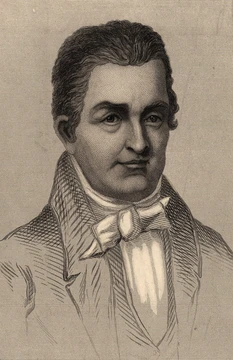
Nathan Read
Last updated

via Wikipedia: Nathan Read · see source
Nathan Read (July 2, 1759 – January 20, 1849) was an American engineer and steam pioneer. Read was the true inventor of the high-pressure steam engine in 1789, twelve years before such an engine was known to be used.
This invention led a great revolution in steam power for navigation and land transport. Read also invented the multi-tubular boiler and developed a chain-wheel for paddle wheels to propel steamboats. Beyond steam, he patented a machine for cutting and heading nails in one operation in 1798, and served as a U.S. Representative and judge.
High-pressure steam engine
Beginning in October 1788, Nathan Read left his previous work to focus on improving the steam engine. He invented and patented the multi-tubular boiler and repositioned the steam cylinder horizontally, allowing the engine to sustain much higher pressure. This created a high-pressure steam engine distinct from James Watt's older design.
Read's engine was more convenient, portable, lighter, and safer, requiring less space and fuel. He built models of a steam car and steamboat in 1790 to demonstrate its usefulness, and the experiments proved successful. He also invented a chain-wheel for paddle wheels to propel steamboats and helped establish a shipbuilding factory in 1796, though no full-scale version of his models is known to have been built.
Politics
Read, a Federalist, was elected to the Sixth Congress to fill a vacancy caused by Samuel Sewall's resignation, and then to the Seventh Congress, serving from November 25, 1800, to March 3, 1803. He did not seek renomination in 1802. In 1803 he became judge of the Court of Common Pleas of Essex County, and in 1807 he moved to Belfast, Maine, serving as judge of the county court of Hancock County that year. He helped establish Belfast Academy and served as its trustee for forty years.
Did You Know?
- Nathan Read developed potassium bicarbonate (KHCO3) in 1788 while running an apothecary store in Salem.
- He was elected a Fellow of the American Academy of Arts and Sciences in 1791.
- Read married Elizabeth Jeffrey in October 1790.
- A sample of his nail machine is owned by the Peabody Essex Museum.
More in 18th-century American Inventors
Sources
Compiled from Wikipedia and the sources listed below. Text from Wikipedia is available under CC BY-SA 4.0; this entry is adapted from it.
- Wikipedia: Nathan Read (CC BY-SA 4.0).
Spotted an error? Know more?
Reader corrections go straight into our review queue. Suggest an edit · How this site is sourced