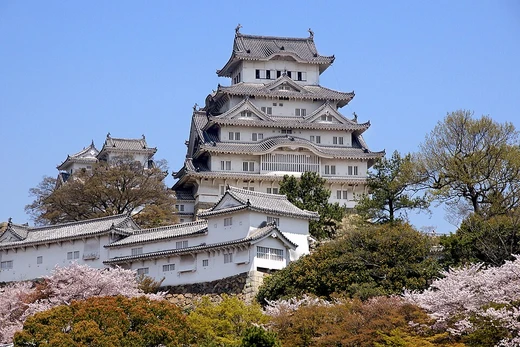
Matsusaka Castle
Ruined hilltop castle of the Kishu-Tokugawa clan.
Last updated

via Wikipedia: Matsusaka Castle · see source
Where it is
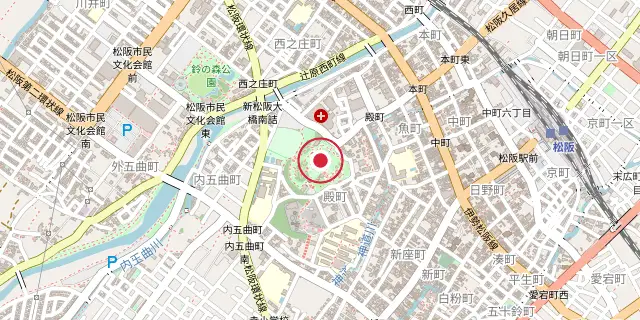
Coordinates: 34°34′34″N 136°31′34″E (34.5760, 136.5260) · Open in OpenStreetMap
Coordinates and connected clubs: the infobox of Wikipedia: Matsusaka Castle (CC BY-SA 4.0). Map: drawn by Codexery from OpenStreetMap tiles.
Now in ruins, Matsusaka Castle stands in Matsusaka, Mie Prefecture. During most of the Edo period, it functioned as a secondary administrative hub for the Kishu-Tokugawa clan of Kishū Domain. It has been a protected National Historic Site since 2011.
Background
The castle stands on the west coast of Ise Bay in central former Ise Province. It controlled a land junction where five roads converged, including routes to Iga, Yamato Province, Kii Province, and Ise Shrine. The castle town of Matsusaka prospered through trade, and its merchants were active nationwide; the founder of Mitsui was born there. The castle occupies a wedge-shaped hill with three terraces.
The Honmaru, a square central bailey at the summit, contained a three-story five-floor tenshu with gold roof tiles on the west and a yagura watchtower on the east. The middle enclosure held a large yagura, and the lowest defenses were divided into several smaller kuruwa. The core area measures roughly 200 meters square, and most walls are faced with stone.
History
During the Muromachi period, the Kitabatake clan controlled the area but were defeated by Oda Nobunaga, who installed his son Oda Nobukatsu as governor. Nobukatsu first resided at Tamaru Castle, then moved to Matsugashima Castle on the coast. After Nobunaga's assassination in 1582, Toyotomi Hideyoshi invaded Ise and installed Gamō Ujisato at Matsugashima as daimyō of a 123,000 koku domain. Because Matsugashima was cramped, hard to defend, and suffering salt damage, Ujisato moved his seat inland to the current site.
Construction was completed quickly using stones from destroyed Buddhist temples and an ancient kofun burial mound. Residents of Matsugashima were forcibly resettled, and merchants were invited from Gamō's former domain in Omi Province. The completed castle had two concentric moats and a three-roof/five-story tenshu. In 1590, the Gamō clan was transferred to Aizu-Wakamatsu (600,000 koku), and Matsusaka Castle passed to Toyotomi retainer Hattori Kazutada.
In 1595, the Hattori were purged with Toyotomi Hidetsugu, and the domain went to Furuta Shigekatsu at 34,000 koku. The castle survived an attack by Ishida Mitsunari's forces before the decisive Battle of Sekigahara, and the Furuta clan was confirmed with 54,000 koku by the Tokugawa shogunate. In 1619, the Furuta clan was transferred to Hamada in Iwami Province, and Matsusaka Domain was abolished, its territories incorporated into the Kishu-Tokugawa clan of Kishū Domain.
In 1644, the tenshu was destroyed by a typhoon and not rebuilt. In 1794, a jin'ya fortified residence was built. The Kishu-Tokugawa clan retained the territory until the Meiji Restoration. In 1877, a fire destroyed the palace within the second bailey, and in 1881 all remaining castle buildings were pulled down except a single rice warehouse.
Present situation
The castle site is now a public park, though little of the original structure remains except its well-kept stone walls. Locals blocked a 1982 plan to rebuild the main keep. Between 1988 and 2003, major repairs to the moats and stonework uncovered that much of the masonry matches the style of Azuchi Castle.
Today, the grounds also house the city hall, a hospital, a history museum, and the Motoori Norinaga Memorial Hall. It is a 15-minute walk from Matsusaka Station. The ruins were listed as one of the 100 Fine Castles of Japan by the Japan Castle Foundation in 2006.
In depth
Oda Nobukatsu initially resided at Tamaru Castle, then relocated to Matsugashima Castle on the Matsuzaka coastline. Despite the "one country-one castle" policy, the fortifications at Matsusaka were retained as an administrative center for the domain’s 179,000 koku holdings in southern Ise Province. The moats and stonework experienced a large-scale repair and reconstruction process between 1988 and 2003.
More in 100 Fine Castles of Japan
Sources
Compiled from Wikipedia and the sources listed below. Text from Wikipedia is available under CC BY-SA 4.0; this entry is adapted from it.
- Wikipedia: Matsusaka Castle (CC BY-SA 4.0).
Spotted an error? Know more?
Reader corrections go straight into our review queue. Suggest an edit · How this site is sourced