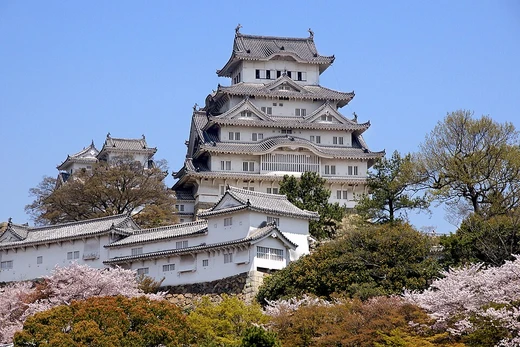
Azuchi Castle
Last updated

via Wikipedia: Azuchi Castle · see source
Where it is
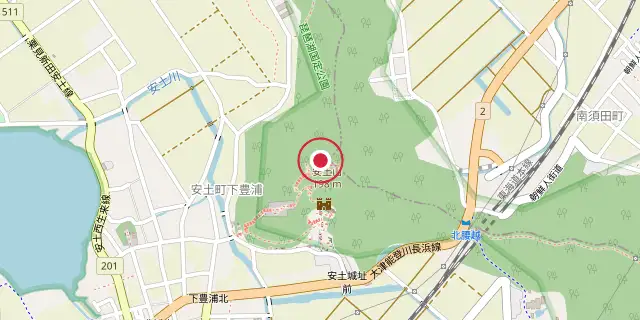
Coordinates: 35°09′22″N 136°08′20″E (35.1560, 136.1390) · Open in OpenStreetMap
Coordinates and connected clubs: the infobox of Wikipedia: Azuchi Castle (CC BY-SA 4.0). Map: drawn by Codexery from OpenStreetMap tiles.
Oda Nobunaga's castle, situated in what is now Ōmihachiman, Shiga Prefecture, was constructed on Mount Azuchi between 1576 and 1579, on the eastern shore of Lake Biwa in Ōmi Province.[1][2] In 1926 the location received National Historic Site status, and this was elevated to Special National Historic Site status in 1952; the castle grounds fall within Biwako Quasi-National Park.[1]
Geography and history
The location was also strategically placed to manage routes between Nobunaga's enemies: the Uesugi, Takeda, and Mōri.[3] Nobunaga built a full castle town with homes for his generals, a Jōdo-shū temple called Jōgon-in, and homes for commoners on the lake shore.[4] He issued a municipal charter in 1577 guaranteeing residents tax immunity and forcing travelers on the Nakasendō highway to lodge in the town.[4] Nobunaga selected that spot because three highways coming from the east and meeting at Kyoto intersected there.[2]
Construction of the castle, overseen by Niwa Nagahide, started in 1576 and reached completion in 1579.[5] Around 5,000 people lived in the castle town by the year 1582.[4] After killing Nobunaga in the Honno-ji Incident, Akechi Mitsuhide had Azuchi Castle torn down in 1582.[3]
What the cited sources add
The Stanford Encyclopedia of Philosophy notes that Azuchi Castle featured paintings of Confucius and Confucian sage figures.[6] This inclusion suggests Nobunaga's thinking was moving from battlefield strategies toward governing the realm and ensuring peace.[6] In his Daigaku wakumon, Banzan proposed restrictions on building Buddhist temples and samurai castles to curb deforestation.[6]
References
- Wikipedia, "Azuchi Castle" (CC BY-SA 4.0), which cites: "安土城跡", Agency for Cultural Affairs (original not read by us) en.wikipedia.org
- Wikipedia, "Azuchi Castle" (CC BY-SA 4.0), which cites: Hinago, "Japanese Castles", Kodansha International Ltd. and Shibundo, 1986, p. 17,28,118–121 (we also read that source) en.wikipedia.org
- Wikipedia, "Azuchi Castle" (CC BY-SA 4.0), which cites: Ōrui, N. and M. Toba (1935). <u>Castles in Japan</u>. Tokyo: Board of Tourist Industry & Japan Government Railways. (original not read by us) en.wikipedia.org
- Wikipedia, "Azuchi Castle" (CC BY-SA 4.0), which cites: Sansom, "A History of Japan, 1334-1615", Stanford University Press, 1961, p. 308 (we also read that source) en.wikipedia.org
- Wikipedia, "Azuchi Castle" (CC BY-SA 4.0), which cites: Kawai, "天下統一を夢見た織田信長", Public Interest Incorporated Foundation, Nippon.com, 3 January 2020; Turnbull, "The Samurai Sourcebook", Cassell & Co, 1998, p. 67–68; Sansom, "A History of Japan, 1334-1615", Stanford University Press, 1961, p. 308 (we also read that source) en.wikipedia.org
- "The Stanford Encyclopedia of Philosophy", Metaphysics Research Lab, Stanford University, 2022. facts only, no text reused. plato.stanford.edu
Each numbered sentence above was checked against the source it cites before publication. Sentences citing Wikipedia adapt text from the English Wikipedia article Azuchi Castle (contributors), used under CC BY-SA 4.0; this entry is available under the same licence. Other sources were used for facts only; no text or images are copied from them.
More in 100 Fine Castles of Japan
Sources
Compiled from Wikipedia and the sources listed below. Text from Wikipedia is available under CC BY-SA 4.0; this entry is adapted from it.
- Wikipedia: Azuchi Castle (CC BY-SA 4.0).
Spotted an error? Know more?
Reader corrections go straight into our review queue. Suggest an edit · How this site is sourced